
Why Knowing Your Warning Signs Matters More Than Knowing Your Dose
I'll be honest — my first few weeks on a GLP-1 involved a lot of late-night Googling. Is this nausea normal? Is this heartburn the medication? Should I be worried about this headache? Most of it was totally normal. But I didn't know that, and so I worried. Then I learned something important: the symptoms worth worrying about are very specific and very different from the routine adjustment symptoms. Having that map in advance would have saved me hours of anxiety and one unnecessary urgent care visit. This post is the guide I wish I'd had.
What the Paperwork Doesn't Make Clear About Side Effects
GLP-1 medications come with a long list of possible side effects in the prescribing information. What they don't do well is tell you which ones are common and mild (nausea, fatigue, loose stools in weeks 1–4), which ones are rare but serious (pancreatitis, gallbladder disease, allergic reaction), and which ones are somewhere in between. The result is that people either dismiss things they shouldn't, or catastrophize things that are normal. The framework I use now is simple: duration, severity, and location. Mild nausea that comes and goes with meals? Normal. Severe abdominal pain that radiates to your back and doesn't improve? Call immediately.
What I Did — Building My Personal GLP-1 Safety System
Made a list of my baseline health markers before starting. Resting heart rate, blood pressure, usual energy level, normal bowel habits. When something changes, I compare it to my baseline rather than guessing. This sounds like extra work; it takes about five minutes and pays off every time something feels off.
Set a standing rule: if a symptom is severe or lasts more than 48–72 hours, I call. Not Google, not a Facebook group — I call. My doctor's office has a nurse line for exactly this purpose. I use it. That's what it's there for.
Kept a side-effect log for the first three months. Date, symptom, severity (1–5), duration, what I was eating, and what helped. When I brought this log to my 90-day check-in, my doctor said it was the most useful thing she'd seen from a patient in months. It helped us make two titration decisions that I think saved me from a lot of misery.
What I Tracked
Every week for the first three months: nausea frequency (number of times per week), bowel movement regularity (daily or not), energy on a 1–5 scale, and heart rate via my watch. These four data points gave me and my doctor a clear picture of how I was tolerating the medication. After three months, I dropped to tracking just heart rate and bowel habits — my two personal canary signals.
What I'd Tell a Friend Who's Just Starting
Prepare your symptom map before your first injection, not after your first bad night. Know what's normal, know what needs a call, and know what's a genuine emergency. Keep your doctor's nurse line number in your phone contacts. And please — if something feels seriously wrong, don't wait to see if it passes. The serious side effects of GLP-1s are rare, but they are real, and early action always leads to better outcomes.
Exercise and Side Effect Management — What to Adjust When
Most GLP-1 side effects are worst in the first 2–4 weeks of a new dose. During that window, reduce workout intensity rather than skipping entirely. A 20-minute walk replaces a 40-minute lifting session. Movement helps nausea in many people — gentle movement, not hard effort.
If you're experiencing significant vomiting or diarrhea, skip the gym and focus on hydration. Exercising while dehydrated on a GLP-1 can worsen dizziness and electrolyte imbalance. Rest is the right call when your body is managing an active symptom load.
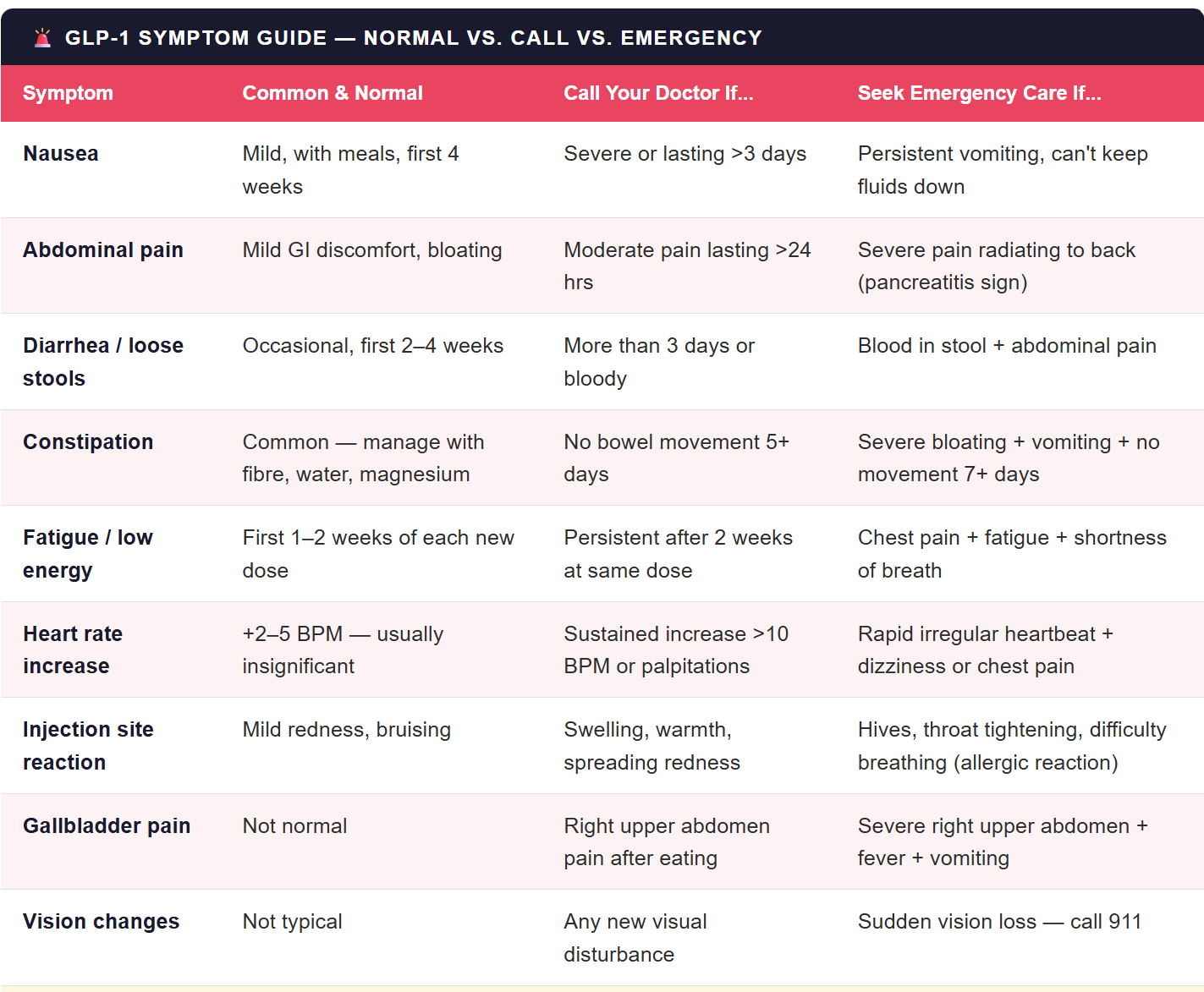
Your doctor's nurse line: Save the number in your phone before your first injection. Use it — that's exactly what it's for.
Pancreatitis warning signs: Severe persistent abdominal pain radiating to the back, worse after eating, with nausea and vomiting. Go to the ER.
Gallbladder signs: Right-side upper abdominal pain after fatty meals. GLP-1s modestly increase gallstone risk — tell your doctor if this starts.
Allergic reaction signs: Hives, swelling of face/lips/tongue, difficulty breathing within minutes to hours of injection. This is an emergency — call 911.
When in doubt: Call. Your doctor would always rather hear from you unnecessarily than not hear from you when it matters.
If this helped
Hit like if this gave you the clarity you needed — and please share it widely. This is the kind of information that genuinely belongs in every GLP-1 starter packet. Drop a comment with any symptom questions you've been sitting on — I'm happy to point you toward resources.
Disclaimer (the boring but important part)
I'm not a doctor, dietitian, pharmacist, or personal trainer. This newsletter shares my personal experience and general information — it is not medical advice and should not be used to diagnose, treat, or replace care from a qualified healthcare professional. GLP-1 medications, supplements, and exercise programs all have risks. Talk with your own doctor before starting, stopping, or changing any medication, supplement, diet, or workout routine — especially if you have an existing health condition.
Sources and Further Reading
GLP-1 side effects and safety profile — FDA prescribing information for Wegovy:
https://www.accessdata.fda.gov/drugsatfda_docs/label/2021/215256s000lbl.pdf
Pancreatitis risk with GLP-1 medications — JAMA Internal Medicine:
https://jamanetwork.com/journals/jamainternalmedicine/fullarticle/1811068
Gallbladder disease and GLP-1s — Diabetes Care, ADA:
https://diabetesjournals.org/care/
Managing GI side effects of GLP-1s — Obesity Medicine Association:
https://obesitymedicine.org/
When to seek emergency care — Mayo Clinic, GLP-1 overview:
https://www.mayoclinic.org/healthy-lifestyle/weight-loss/in-depth/weight-loss-drugs/art-20044832
Stay steady out there, Alex — Steadyafter50.com