The Moment I Realized I Could Steer This
For most of this journey I thought of weight loss as something that happened to me. I took the shot, the appetite went quiet, the scale went down. My job was to hang on and not mess it up. It never once occurred to me that I could reach up and turn the speed down myself — that the pace of the loss was a dial, not a fixed setting.
Then I got close to the number I’d been chasing, and a different fear showed up. Not the fear of not losing. The fear of losing too fast, blowing right past maintenance, and ending up somewhere I didn’t want to be — gaunt, tired, and with the whole thing feeling like it had happened without my consent. That’s when I decided to run an experiment on the only test subject I had available: me.
I want to be honest right up front. What follows is not a protocol. It is one woman in her 60s treating her own body like a science project, with her doctor in the loop and one dose of her current level sitting in the refrigerator. I’m sharing it because I couldn’t find anyone else talking plainly about it — not because you should copy it.
Why I Didn’t Want to Crash Into Maintenance
Here’s the thing nobody warns you about. When you’re losing a pound or two a week and feeling great, “goal weight” feels like a wall you slam into. One week you’re above it, the next you’re below it, and your body has no idea a finish line just went by. The appetite suppression doesn’t check the scale. It just keeps working.
I didn’t want to slam into the wall. I wanted to coast up to it. The image in my head was a driver easing off the gas a quarter mile before the stop sign instead of standing on the brake at the last second. Same destination. Completely different experience for everything inside the car — in my case, my energy, my face, my muscle, and my sanity.
So the goal I set for myself was deliberately un-dramatic: slow the loss down to zero and maintain that for a few weeks. Show that I could maintain my weight on purpose and slow it down to a pound a week afterwards. To be more deliberate with my goal setting based on my experience. Learning about maintenance and losing weight is what I needed. I know how to gain weight.
I look in the mirror and see myself again. I haven’t recognized my old self in a long time and it’s kind of nice. However, I have a partner that didn’t know me at a lower weight and definitely says things about my thin face. So that got me a bit worried. I studied “ozempic face” a bit to understand the term and reasons for it. I decided that I would slow things down because rapid weight loss is one of the reasons for it. You cannot really avoid it if you are losing a great deal of weight. Your body will change. You will change. It only makes sense and I will keep on my plan to get healthier and use this medication to do that.
What Slowing Down Actually Looked Like
The mechanical part of this — the dose part — was a conversation with my doctor, and I’ll write about the full up-and-down arc separately. For this piece, what matters is what I watched week to week once the loss started decelerating. Because slowing down isn’t a single decision. It’s a series of small readings you take off your own body, like checking gauges.
Here is what I paid attention to, roughly in order of how much it told me:
The rhythm of the scale, not the number. I stopped caring what any single morning said and started caring about the slope over two weeks. Dropping three pounds in seven days told me I was still going too fast. A slow, boring drift of about a pound a week told me the dial was set right. Boring was the goal.
Hunger coming back — and whether I welcomed it. When I was losing fast, I basically had no appetite, and I’d stopped noticing that wasn’t normal. As things slowed, a gentle, ordinary hunger returned before meals. Early on that scared me. Then I reframed it: that quiet hunger is what maintenance is supposed to feel like. It’s the signal I’ll have to live with long-term, so I wanted to meet it while I still had support in place.
Energy in the afternoons. Fast loss came with a 3 p.m. flatness I’d written off as “getting older.” As the pace eased and I kept my protein up, the flatness lifted. That told me I’d probably been under-fueling during the quick phase without realizing it.
Whether the loss stopped on its own. The real test of maintenance isn’t losing slowly. It’s the scale flattening out and staying flat. When my weight parked itself in a two-pound window and just sat there for a couple of weeks, that was the answer I’d been experimenting to find: I could arrive, and stay, without the number sliding either direction.
The Week It Clicked
There was one particular week it all came together. I’d been hovering in the same two-pound band for about ten days. I ate normally — protein first, a proper dinner, even a dessert — and the scale didn’t punish me for it. I felt hunger before lunch and it was fine. My afternoon energy held.
And I realized: this is it. This is maintenance. Not a magic state I’d graduate into someday. I’m still taking the medication but found a lower level that worked for maintenance. That was something my doctor did not help with though. I have guidance but there’s still a lot that’s not known. Is there a tolerance built up or is that just something they say? Will you put it all back on if you slow or stop meds altogether? Well, I still had a script from my doctor that was a few steps lower dosage than the highest level I was currently at. I decided to go that dosage and find out if it still worked. The pharmacist I talked to said it wouldn’t and the dosage I was at was needed. That doesn’t seem to be the case. Maybe it’s not as strong but do I need that kind of strength when I’m getting closer to end goal? I wasn’t just starting out with a lot to lose. I was already down 65 pounds with no plan from the doctor or me about when I should slow down, how much I should weigh, how I should treat health issues, if I take this forever? All sorts of stuff I really didn’t know. I had to research for myself after not getting sufficient information or assistance from said doctor and pharmacist. I did find I could hold to a weight with the habits I already had been learning thru this process. Nobody scripted that week for me. I steered into it. After months of feeling like the medication was driving, that was a genuinely emotional thing to notice.
I felt, and I mean this affectionately, like a science experiment that had finally returned a clean result.
The Honest Caveats
I need to hold two things at once here. One: I’m proud of steering this myself and I think more people should know it’s steerable. Two: I am an n-of-1, I’m not a doctor, and “I did this and it worked for me” is the single most dangerous sentence in health writing when it’s read as instruction.
So the caveats, plainly:
Every dose decision I made was known to my prescriber and came from the same company. I did not freelance my medication, and I’d never suggest you do. The steering I’m describing is about reading your body and having informed conversations — not DIY dosing.
What reads as “slow enough” for me may be wrong for you. Your labs, your history, your other medications, and your reasons for being on this at all are yours, not mine.
Regain is real and it’s sneaky. Arriving at maintenance deliberately is the start of the maintenance job, not the end of it. I still weigh in weekly and I still eat like someone who respects how easily the noise comes back.
If the hunger returning ever tips from “ordinary” into “constant and distressing,” that’s a doctor conversation, not a willpower contest.
The point of the whole experiment wasn’t to prove I could outsmart my doctor. It was to learn my own body well enough that our conversations got better — so I walk in with real readings instead of vague vibes, and we make the next call together.
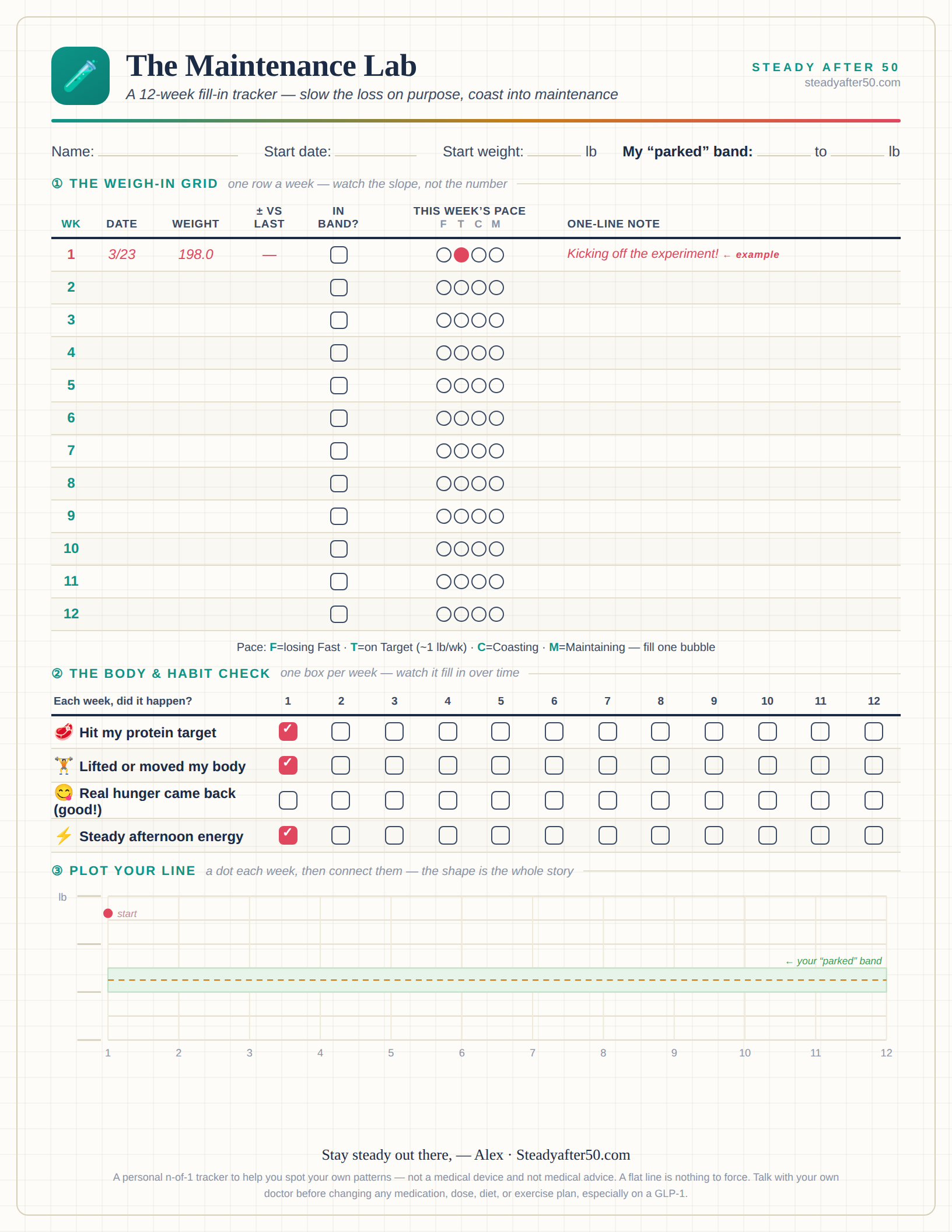
Here’s a tracker if you need it:

If this helped
Hit like if the idea of easing up to maintenance instead of crashing into it is new to you — it was brand new to me not long ago. Drop a comment and tell me what you watch week to week on your own journey; I’m genuinely collecting these. And share this with the friend who’s terrified of what happens when the losing stops. That fear is exactly why I wrote it down.
Disclaimer (the boring but important part)
I’m not a doctor, dietitian, pharmacist, or personal trainer. This newsletter shares my personal experience and general information — it is not medical advice and should not be used to diagnose, treat, or replace care from a qualified healthcare professional. GLP-1 medications, supplements, and exercise programs all have risks. Talk with your own doctor before starting, stopping, or changing any medication, supplement, diet, or workout routine — especially if you have an existing health condition.
Sources and Further Reading
Once-Weekly Semaglutide in Adults with Overweight or Obesity (STEP 1) — New England Journal of Medicine, 2021:
https://www.nejm.org/doi/full/10.1056/NEJMoa2032183
Weight regain after withdrawal of semaglutide (STEP 1 extension) — Diabetes, Obesity and Metabolism, 2022:
https://dom-pubs.onlinelibrary.wiley.com/doi/10.1111/dom.14725
Obesity is a chronic disease — Cleveland Clinic:
https://my.clevelandclinic.org/health/diseases/11209-weight-control-and-obesity
Prescription medications to treat overweight and obesity — NIDDK (NIH):
https://www.niddk.nih.gov/health-information/weight-management/prescription-medications-treat-overweight-obesity
Stay steady out there,
Alex — Steadyafter50.com