
Here’s what I’ve since learned about maintenance dosing — including a trial published in May that answers the question almost nobody knows exists.
I’m putting this out there for everyone else. I don’t think my doctor is the only one prescribing the way the manufacturer recommended a year or more ago. However, there’s more studies, surveys, patients and information over that time. I feel like I have spent a few months fighting throwing up the day after my shot and a few days of heavy nausea. I’ve been learning what I can on my own and with AI aided research because my doctor’s office doesn’t seem to have the dosing recommendations for me. Granted, I am prescribed by a cardiologist and didn’t have diabetes. My health stats have improved and that’s what he’s seeing. I’m experiencing it and happy for it and want to maintain it. I don’t want to lose the benefits I’ve been experiencing with ease of movement, able to do things I haven’t in years it seems, finding clothing in sizes that fit, lowered pain, lowered inflammation, and just general well being and happiness. I don’t want to give that up. I just want to match a dose with my current weight to help me get to a maintenance level for the time being. I’m not ready to stop cold turkey and go it alone. Some may see these meds as cheating but I don’t. I tell people that because I do want them to know how I lost the weight. This is not a secret but a method I used after decades of being overweight. This is not the hollywood treatment this is real life stuff, life changing.
Sixty-two pounds down. Ten to go. And the medication that got me here is making me throw up every week and feel nauseous for a few days.
So I did what you’re supposed to do. I asked my doctor. And I asked a pharmacist from the manufacturer, online.
The pharmacist told me to eat bland food.
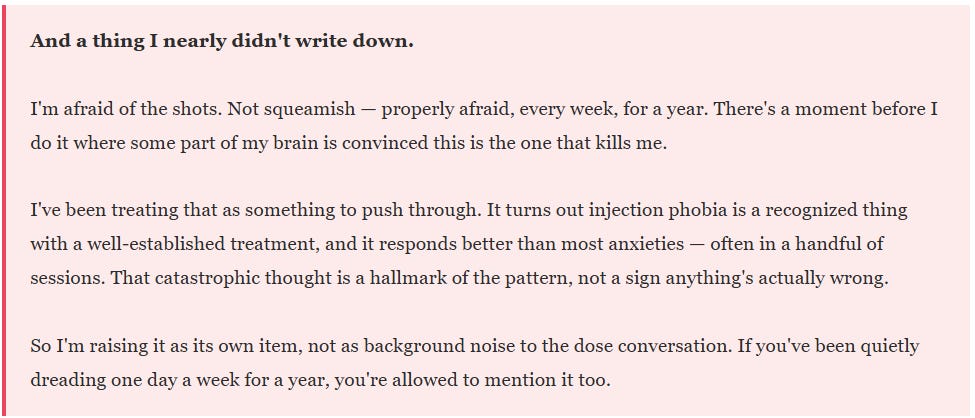
And my doctor — I think — heard the problem and concluded I wanted off the drug. Which was never what I was asking. I don’t want to stop. Stopping means gaining back fifteen or twenty pounds and losing strength I’ve spent a year and a half building. I want to stay on it. I just want to be on a dose that doesn’t have me over a sink.
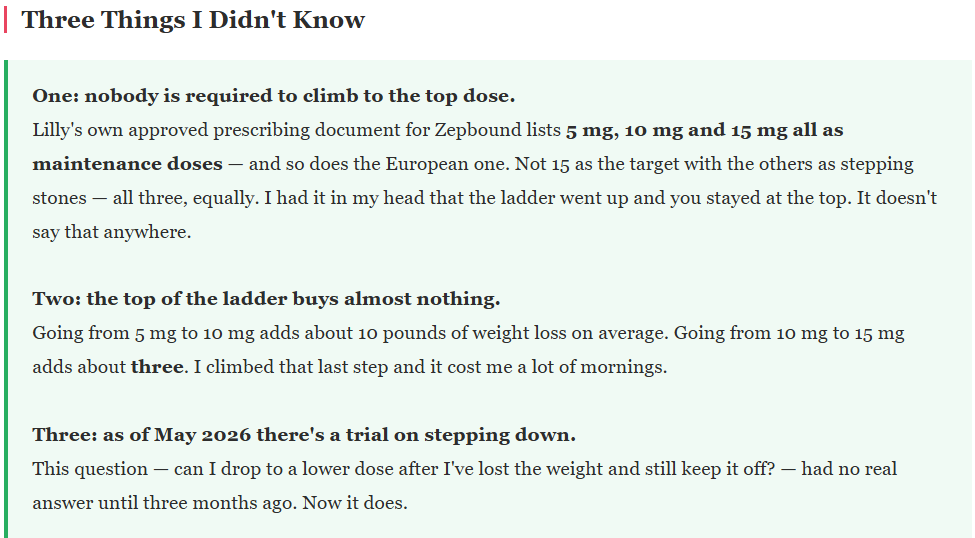
That gap — between “I’m struggling” and “I want to quit” — turns out to be where a lot of people get stuck. So I went and did the research I should have brought to that appointment in the first place, and I found three things I didn’t know. One of them is a trial that was published in May.
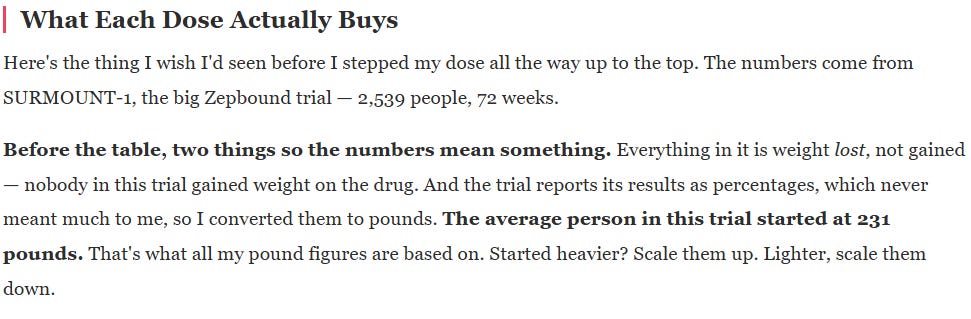
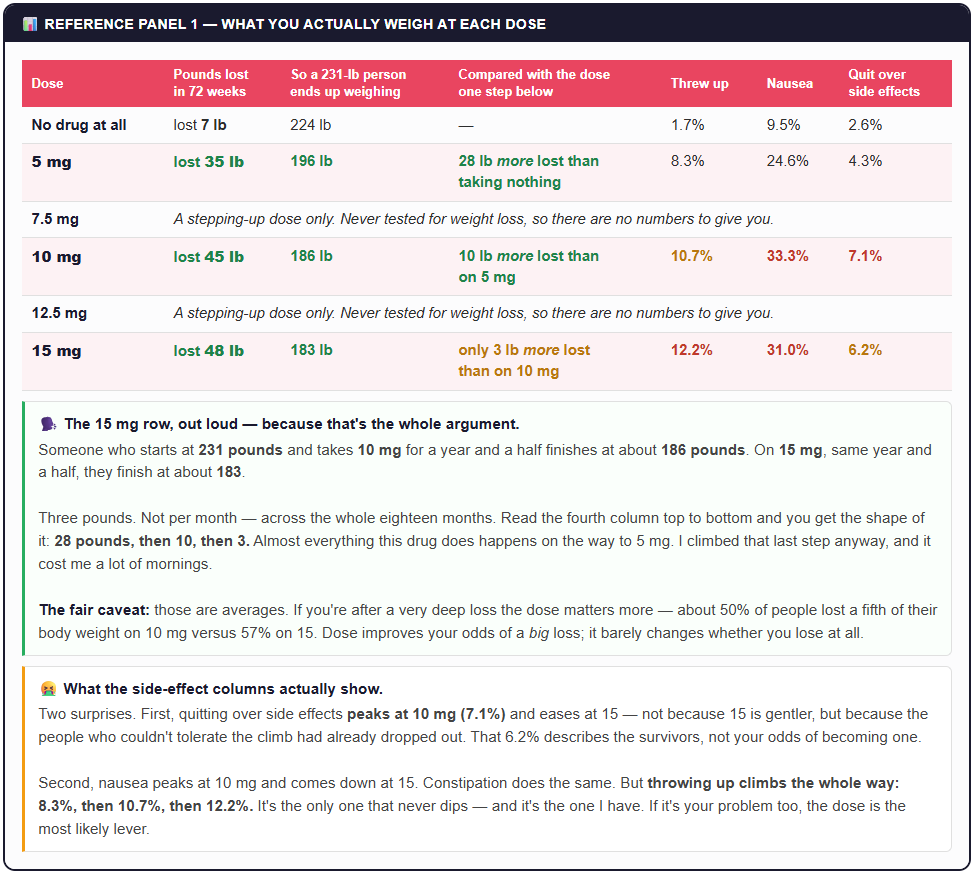
Those two blank rows are the honest part. I’m on 12.5 mg as I write this, and I can’t tell you what it does for me, because nobody tested it. The trial studied 5, 10 and 15 mg only. The in-between doses exist so your body has a gentler way to climb — they were never studied as places to stay. It’s reasonable to guess 12.5 lands somewhere between the 10 and 15 rows, but that’s a guess, not a finding, and I’d rather hand you an empty box than a number I made up.
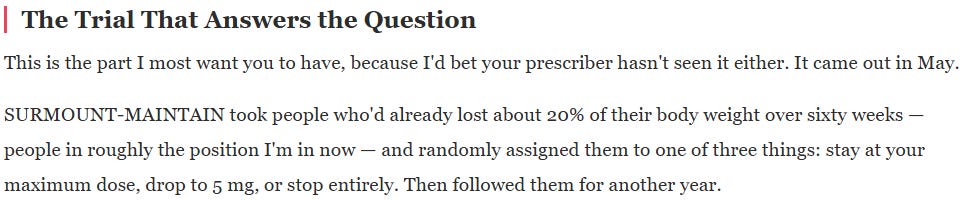
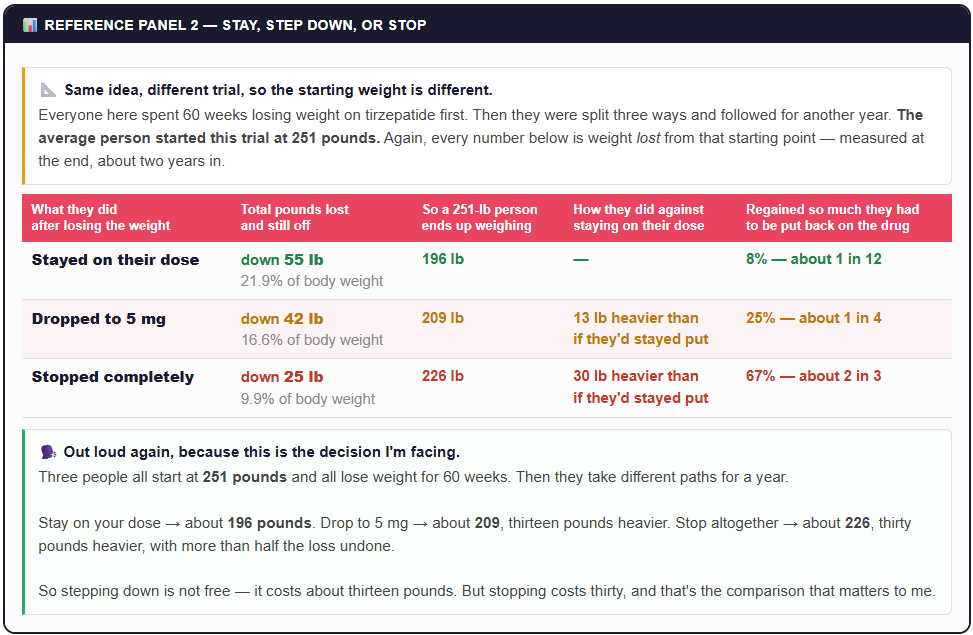
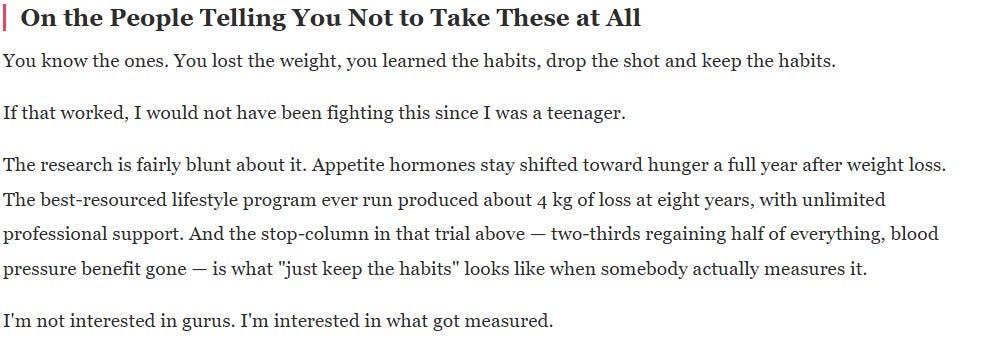
About that last column. The trial had a rule built in: from week 84, anyone who had regained half or more of what they’d lost was put back on tirzepatide. So it isn’t a side effect or a separate measurement — it’s the plain version of how many people this went badly for. One in twelve who stayed put. One in four who stepped down. Two in three who stopped.
One gap: the trial says the blood pressure effect depends on dose but doesn’t print the numbers, so I can’t quote them. That question has a good answer elsewhere — it’s the next section, and it changed what I’m going to ask for.
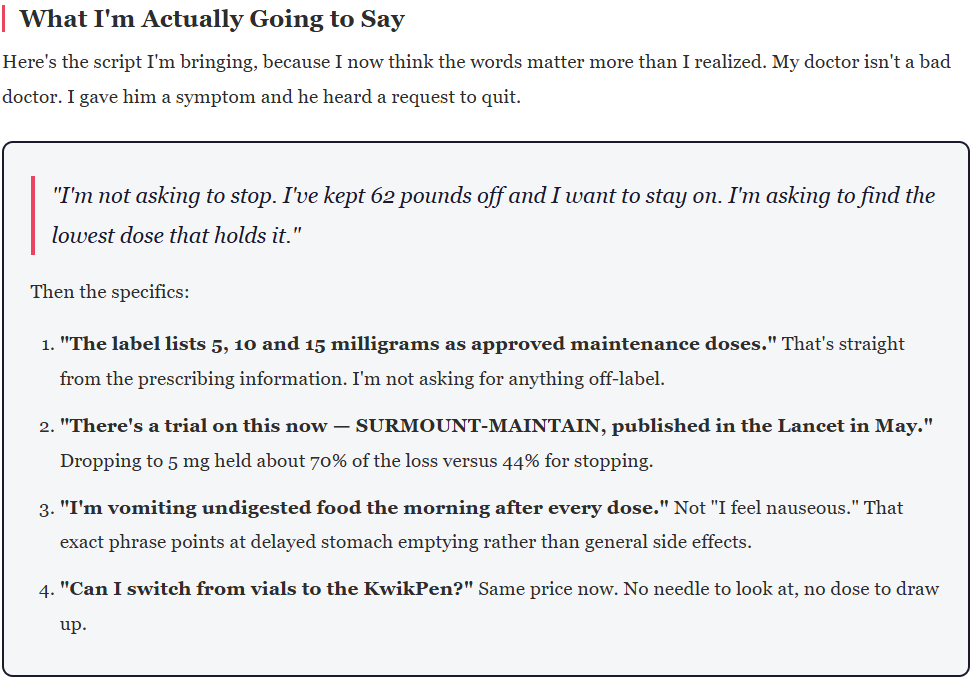
That’s the number I’m bringing to my next appointment. Not “this is hard,” which apparently sounds like a request to stop. But: there is a published randomized trial on the specific thing I’m asking for, and here is what it found.

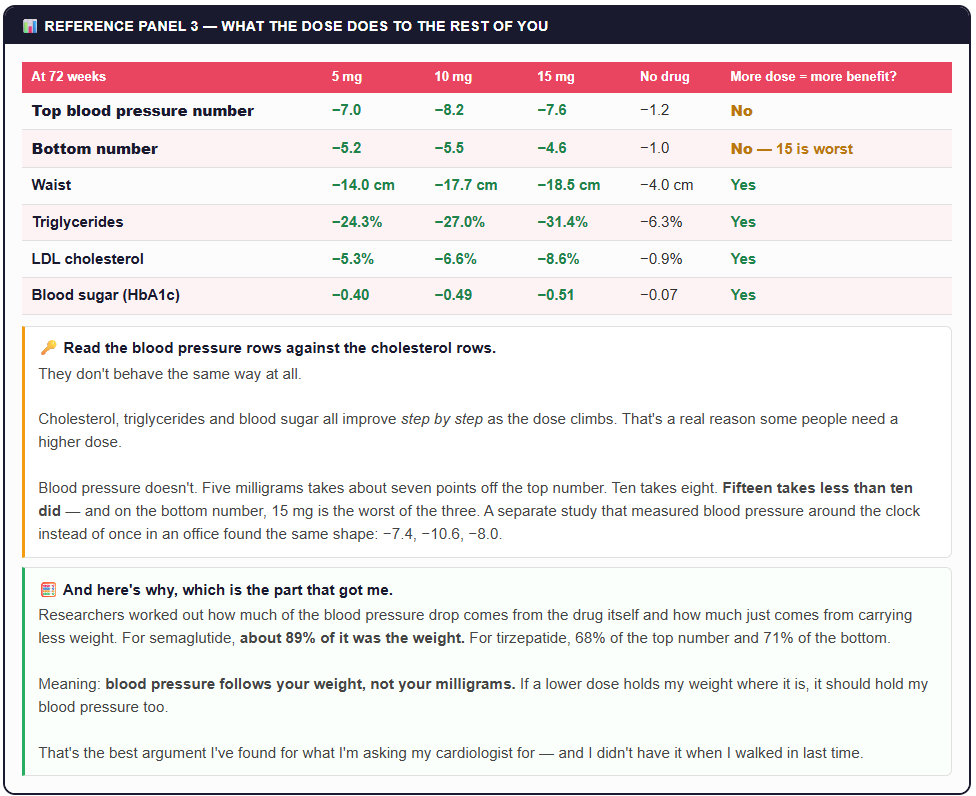
One fair counterweight before you take that too far. Protection against heart attacks and strokes is not mostly a weight-loss effect. In the big heart trial only about a third of the benefit was explained by smaller waistlines. Something else about the drug is doing the rest. So: a lower dose, fine. Off the drug entirely is a different question.
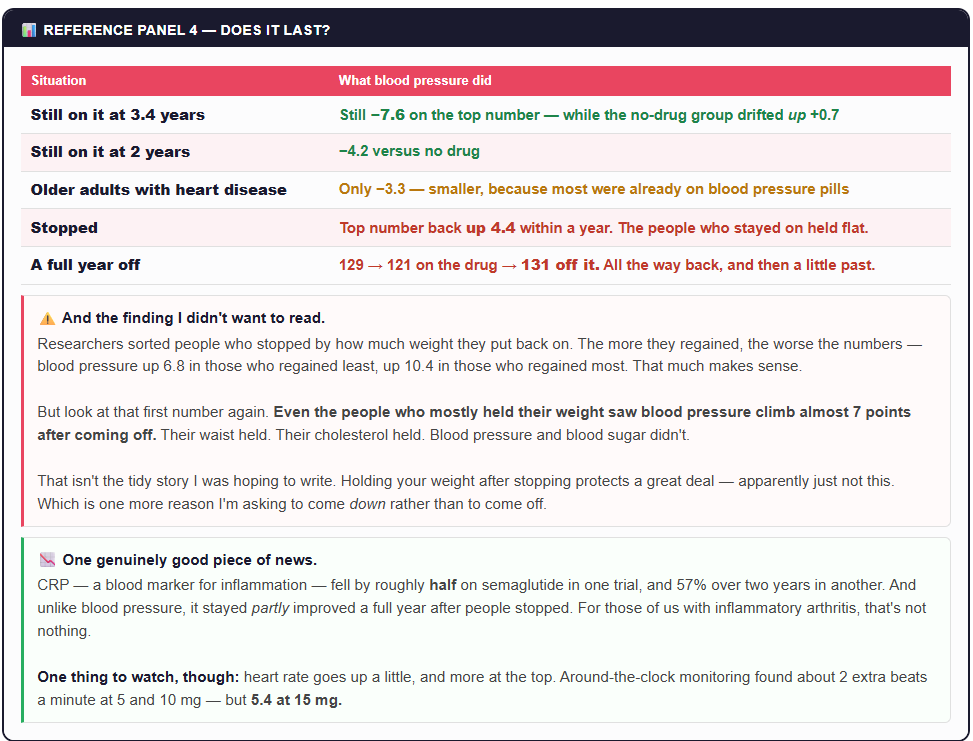
And then there’s the question none of us really wants to ask, which is what happens if you stop.
One honest catch, if you prefer European sources. That sentence — the one I’m going to say out loud at my appointment — is in the American prescribing document. I checked the European one, and there’s no equivalent line in it. Europe lists the same three maintenance doses and says you only go above 5 mg “if needed,” and the UK’s guidance says “highest tolerated dose” rather than “maximum dose,” which amounts to the same thing. But the one clean sentence you can quote is the American one.
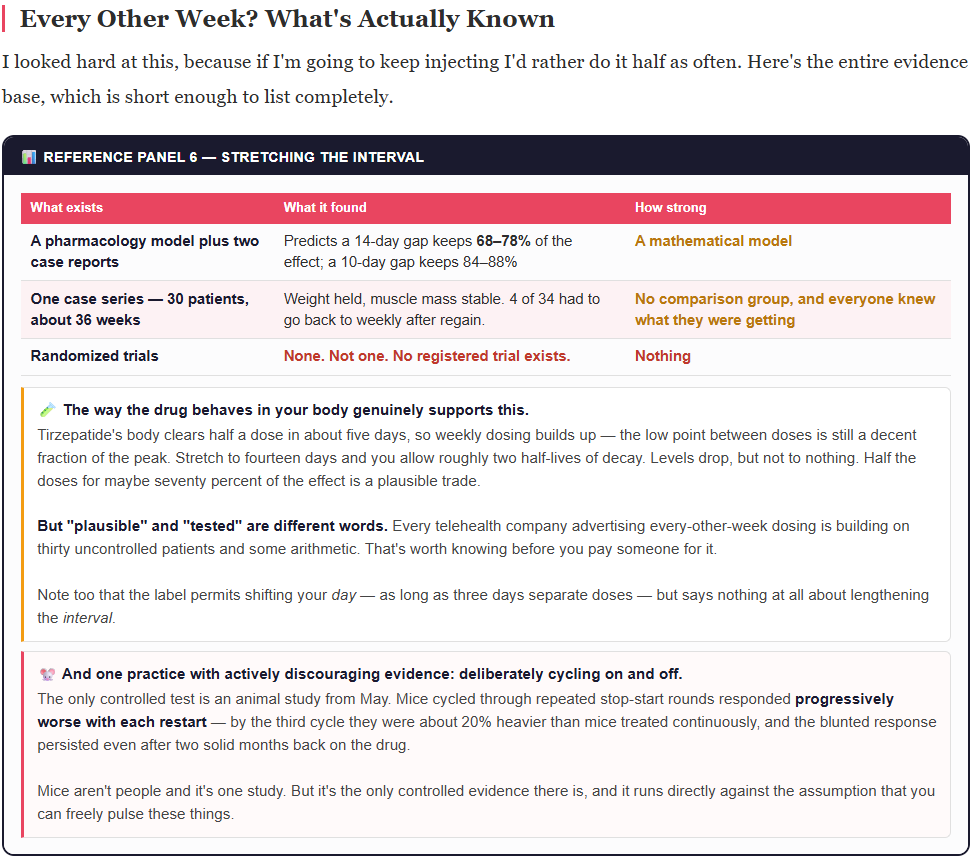
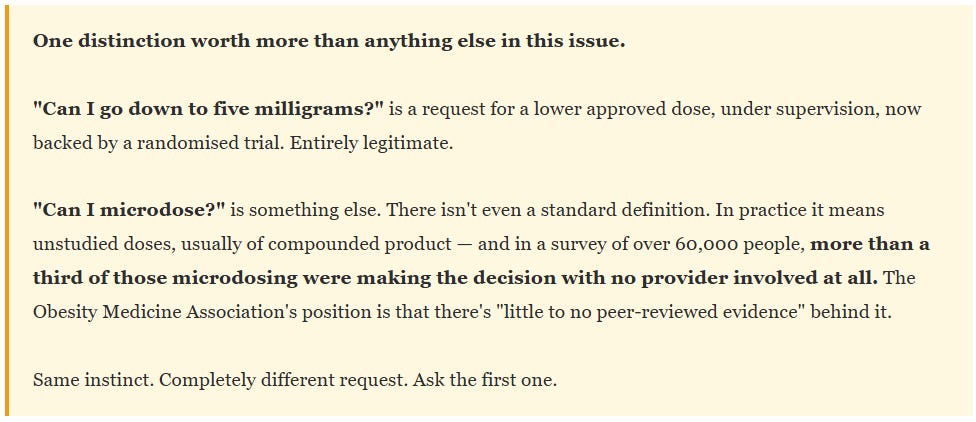
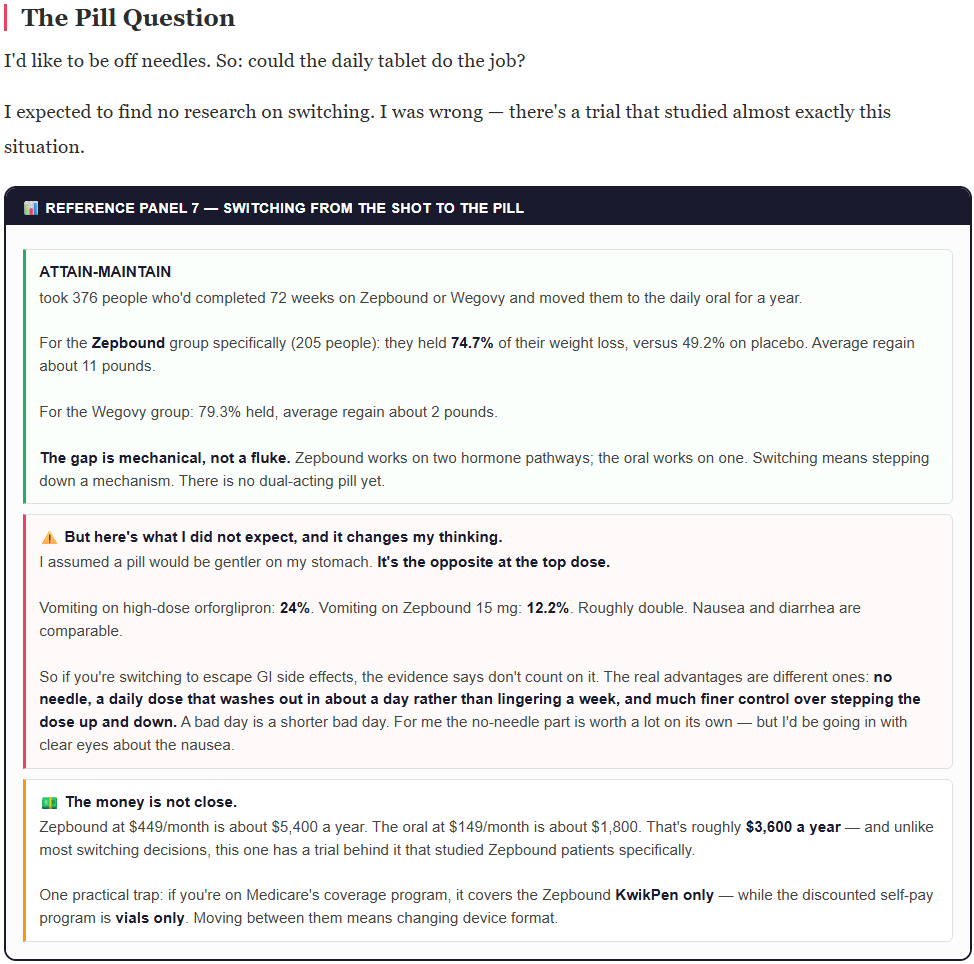
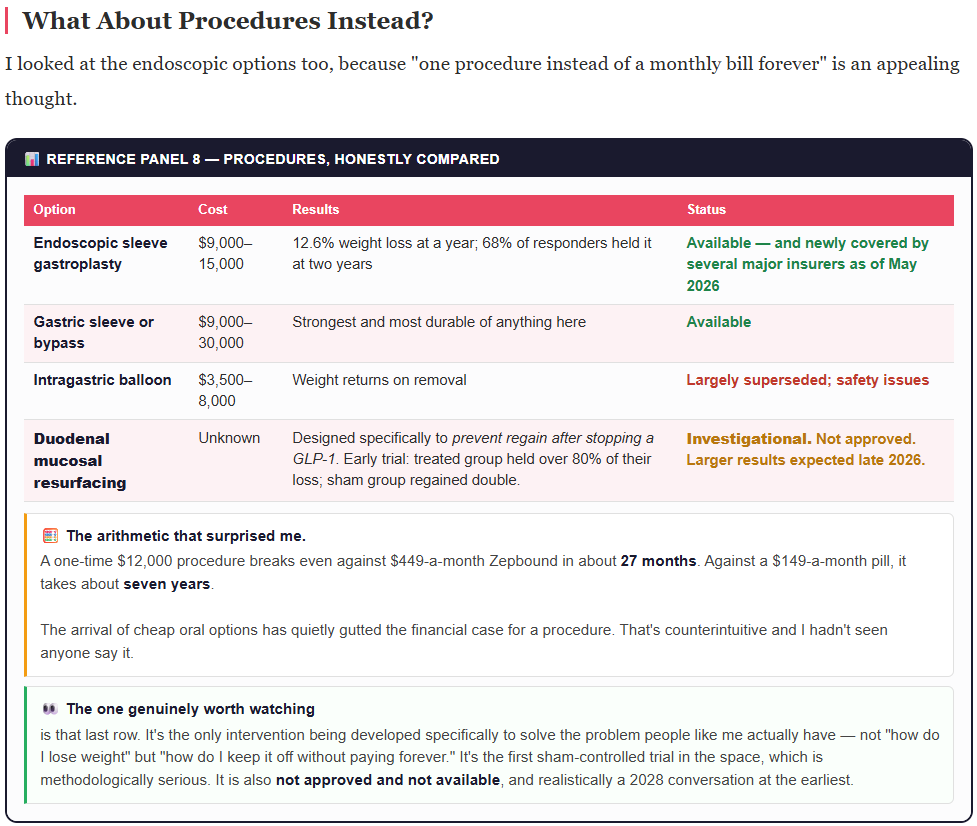
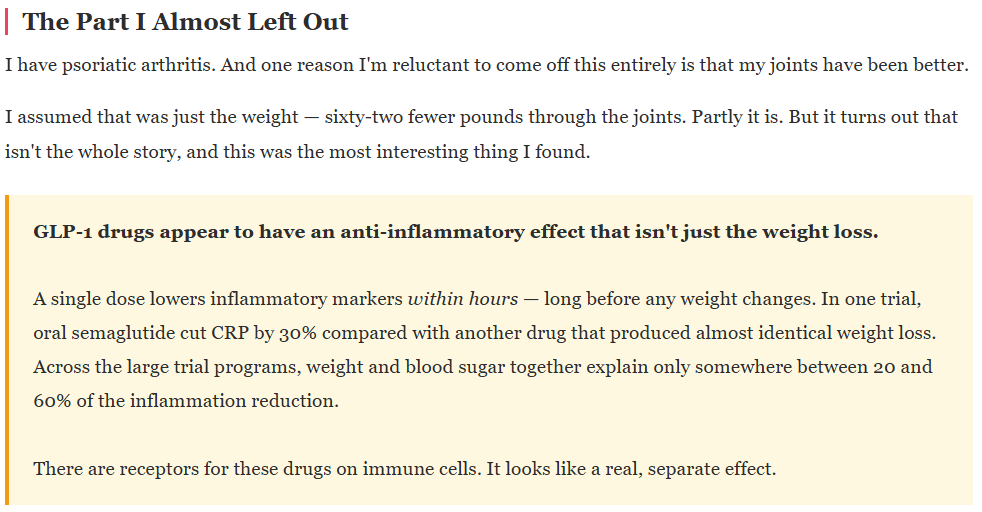
For psoriatic arthritis specifically the evidence is thin. One study of 48 people found pain improved significantly — but the overall disease activity score didn’t reach statistical significance. The skin evidence in psoriasis is stronger than the joint evidence.
And here’s the gap that matters most to my decision: nobody has measured what happens to inflammatory disease activity when you stop. Not in psoriatic arthritis, not in rheumatoid, not in psoriasis. Every study is on-treatment. The withdrawal question is completely unstudied.
So for me that’s a reason to talk to a rheumatologist rather than a reason to decide anything on my own. But if you’re on one of these drugs and also have inflammatory arthritis, it’s a factor in the stay-or-stop question that I hadn’t seen anyone mention.
Sources
Dosing and the label: Zepbound (tirzepatide) approved prescribing document, rev. 02/2026 — Lilly’s own document · SURMOUNT-1, NEJM 2022
The step-down trial: SURMOUNT-MAINTAIN, The Lancet, May 2026 · ACC summary
Real-world dosing: Samuels et al., Diabetes Obesity & Metabolism 2025 · Obesity Association Standards of Care, 2026 · STAT on microdosing, May 2026
Extended intervals and cycling: Reduced-frequency case series, Obesity 2026 · Pharmacokinetic model, Obesity 2025 · Cycling and therapeutic resistance, JCI Insight, May 2026
Switching to oral: ATTAIN-MAINTAIN · Weill Cornell summary
Procedures: MERIT trial review, endoscopic sleeve gastroplasty · REMAIN-1, duodenal mucosal resurfacing
Inflammation: Wong & Drucker, Journal of Clinical Investigation, Nov 2025 · Haberman et al., psoriatic arthritis, Arthritis & Rheumatology 2026
Blood pressure and the rest of your numbers: SURMOUNT-1 by dose, NEJM 2022 (supplementary tables) · 24-hour blood pressure substudy, Hypertension 2024 · European Heart Journal 2024 — how much of the blood pressure drop is the weight (89%) · What reverses after stopping, JAMA Internal Medicine 2025 · STEP 4 withdrawal trial, JAMA 2021 · Three-and-a-half-year data, NEJM 2024 · SELECT — how much of the heart benefit is the weight, The Lancet 2025
Procedures and anesthesia: Multisociety perioperative GLP-1 guidance, October 2024
Stay steady out there,
Alex — Steadyafter50.com