
A Simple Question With a Messy Answer
I set out to answer something that should have taken thirty seconds: what percentage of my body weight have I actually lost?
I must admit that I wasn’t sure this medication would work for me. It took me almost 6 months to start it after my cardiologist met with me and wrote me a script. I’m not sure why I waited except I wanted to make sure if I started it I could keep affording it and keep going. The prices are high and it was all out-of-pocket. I remember thinking that I could afford 6 months and do a pretax health account for the following year. But 9 months of the meds was going to be harder. So, I started taking Zepbound injections last August. It’s close to a year since I began.
I think I have accomplished much of what I wanted thru this experiment. Main goaols were to improve health stats, lose weight and avoid knee replacement. I have been researching and learning how to use the glp1 meds to my advantage. It has helped me keep a calorie deficit needed to lose the weight. People will say that we can do this on our own. I have done this before, in my early 40’s and lost about 80 pounds on a 900-1200 calorie daily diet. Unfortunately, I put it all back on after a year or two. This has been a lifelong issue for me from about 12 years old on. Turning the “food noise” off is kind of weird and wonderful at the same time. It doesn’t last all week on a weekly shot. I can have less of an appetite after a shot and more of an appetite before a shot. Mostly I’ll eat about half as much as I used to and feel satisfied. Good nutrition is the hard part. So that never changes but I do make better food choices. What I like to eat has changed a bit along the way.
Now I wish I had kept better track and taken some selfies and measurements at the beginning and along the way. Most diet or nutrition changes do go that way, at least on a program it does. You do need a starting line and baseline to figure things out. I have a pic from last March 2025 showing much how I looked at the start. I didn’t weigh myself a lot during the first 6 months before I got on an weekly or bi-weekly cadence of taking a pic of the scale. That was part of my way of dealing with change and not paying attention to the pace. I also wasn’t sure it would work long-term for me.
I’ve been researching different glp1s and prices recently. That’s when I started paying more attention to stats for weight loss on the different meds. I wondered how I stood compared to the stats they publish on the websites and show in little letters at the bottom of commercials. I provided numbers pulled from memory — started around 235 pounds, staying around 178 pounds for a few weeks. Then I went and pulled the actual scale photos I took. There’s seventeen of them going back to August of last year. And the real numbers didn’t just refine the estimate. They corrected a story I’d been telling myself.
I want to walk through what I found, because I suspect a lot of you are carrying around a version of your own progress that may not match the facts. And in my case the log was kinder than the memory, which is not the direction people expect.
The Actual Number

For context in the big published trials, tirzepatide averaged about 20.9% over 72 weeks and semaglutide about 14.9% over 68. I’m not saying that to brag, and one person is not a trial. I’m saying it because if you’ve been grinding along feeling like you’re behind, don’t be discouraged. Keep track of your loss. Check your numbers and watch your nutrition. Remember that slow weight loss is good and plateaus and vacations happen.
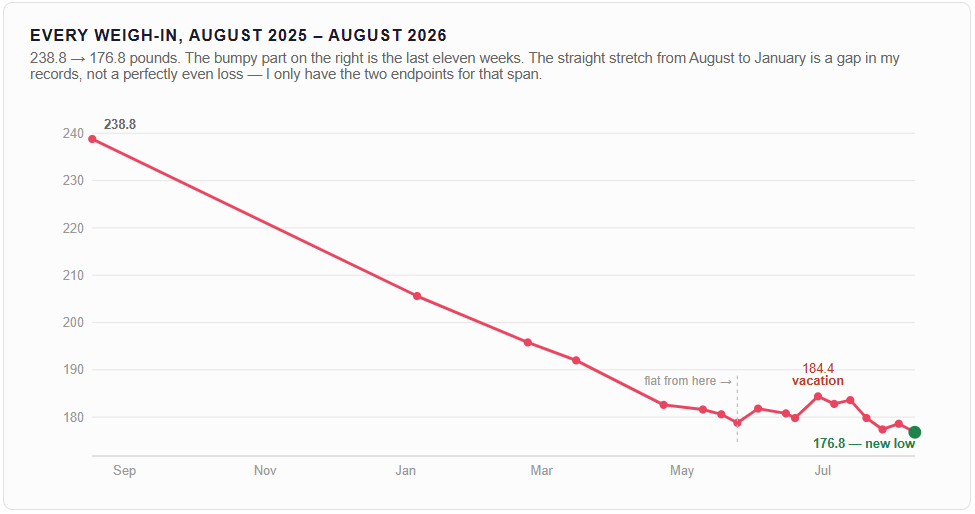
What I Got Wrong About My Own Year
Here’s the part that surprised me. If you asked me when I stopped losing, I said February. I really thought February felt like things levelled off and I shifted into holding and maintenance.
On February 23 I weighed 195.8. On May 25 I weighed 178.8.
That’s seventeen more pounds — better than a quarter of the entire year’s loss — during a stretch I had mentally filed under “maintaining.” I lost a quarter of my total in a period I don’t remember losing anything in.
I’ve thought about why, and I think it’s the first thirty pounds are much more noticeable. My clothes stopped fitting, people would say things as they notice, the scale moves in chunks you can see when you’re looking for a certain weight to hit or get under for the first time in years. The next seventeen came off at a pound and a half a week across three months. And a pound and a half a week is just not as noticeable. So I’ve created a different story and the scale pics put it into perspective.
If you’ve been at this a while and feel like you stalled out somewhere. I’d genuinely encourage you to go pull your actual numbers before you accept that. Mine were better than my memory of them, and I don’t think I’m unusual.
The Whole Log, Including the Ugly Parts
Here is every weigh-in. I didn’t weigh consistently as I went thru this and wish I had for better stats. It’s a numbers game so it helps to keep from having gaps. I suppose this will all go longer so I will keep taking pics and tracking weight. I’ve left in the four weigh-ins that showed increases, because those are the ones that actually matter to anybody reading this.
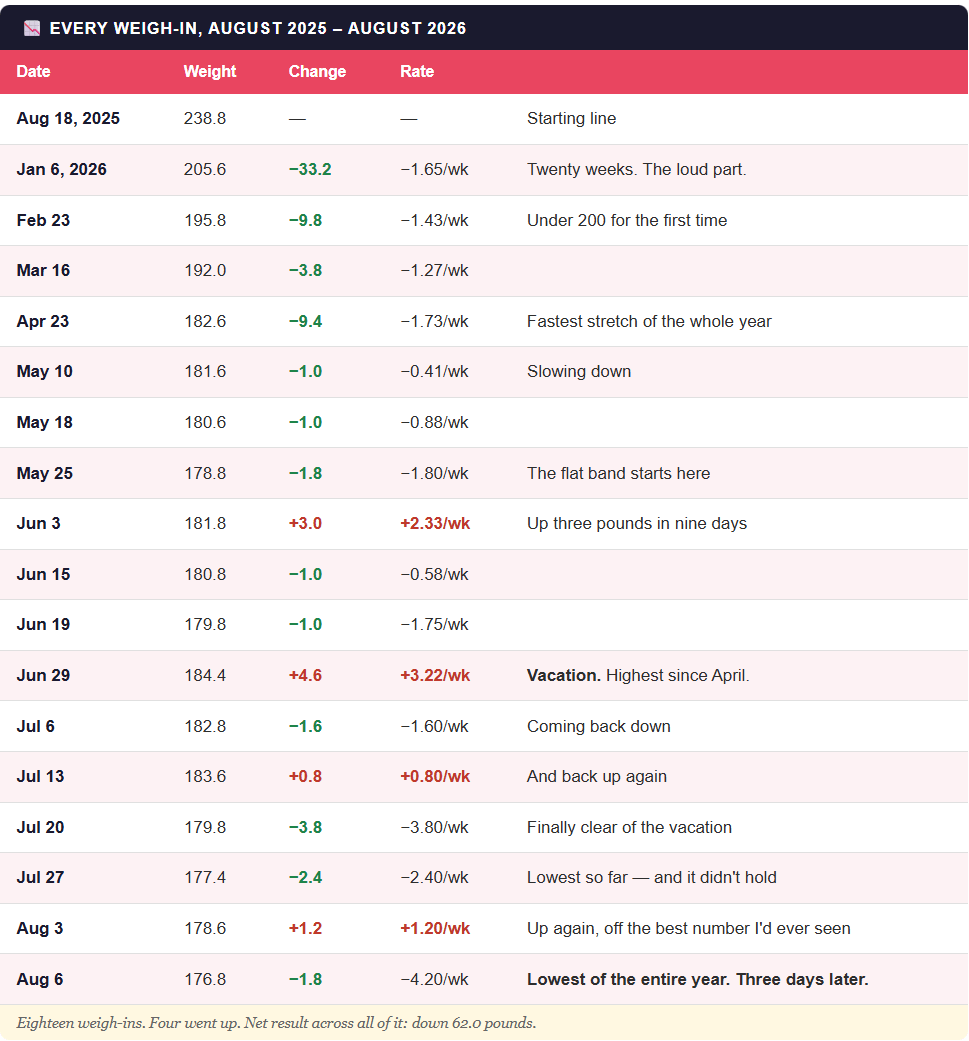
Four Weights Out of Eighteen Increased
Count them in that table. Four weigh-ins showed a gain. That’s better than one in five.
I want to let that gel, because I think it’s the single most useful thing in this whole issue. Roughly one in five times I stepped on that scale, it told me I’d gone backwards but I still finished the year down sixty-two pounds.
Every one of those four mornings was a morning I could have decided this wasn’t working. June 3rd I was up three pounds in nine days and hadn’t done anything differently. July 13th I was up again after already starting to recover from vacation, which felt like the recovery had failed. And on August 3rd I was up 1.2 pounds off the best number I’d ever seen, which is exactly the sort of thing that ruins a Monday if you let it. Today, I weighed 176.8 — the lowest of the entire year. I did experiment with a lower dosage in July to see if I could reduce side affects, level off for a maintenance period and then start losing again. I want to make sure my problem isn’t maintenance. I’ve proved all that to myself and more. I can go on vacation, gain a few pounds and come back and restart the habits I’ve been practicing and lose again. That’s the pattern across all four increases. These are the raw stats, and you can read it straight off the chart.
The Vacation, In Detail
The late-June trip is worth its own section because it’s the most honest thing in the log.
June 19 I was 179.8. Ten days later, June 29, I was 184.4. Up 4.6 pounds.
I wanted to lose the vacation weight but I didn’t want it to go too fast. A loss of about .5 to 1.5 pounds a week not 2 pounds or more which is harder than it seems. It took twenty-one days to get back under my pre-vacation number. Three full weeks. And it wasn’t a clean line down — a week into the recovery, on July 13, I went up again. If I’d been reading the scale as a verdict rather than a data point, July 13 would be hard to take.
Twenty-eight days after the peak I hit 177.4, and thirty-eight days after it I hit 176.8 — the lowest weight of the entire year, and the first time I’ve been under 177.
Four and a half pounds gained on vacation took about a month to lose and included another gain along the way. Then it kept going past where it started. So this lesson is to deal with weight gains calmly and budget a month, or a few weeks, depending on the gain and don’t panic at a few pounds. I know I will start taking a closer look at foods and what I’m eating and how much I’m exercising if gains keep happening. A food journal will be needed for that to work well.
Sixty-Two Pounds Is Not the Same as Arriving
Here’s the part I want to be careful about, because there’s a temptation in this genre to let a big pounds number imply you’ve crossed some finish line.
I ran my own BMI while I was doing this arithmetic. What I found is that sixty-two pounds moved me out of one category and barely into the next one — not into the “normal” range, just cleanly out of the worst one, and by a smaller margin than sixty-two pounds sounds like it should buy you. I’m not going to print my height and my exact numbers here. You don’t need my whole file to get the point, and the point isn’t about me.
The point is that pounds lost measures the journey, not the destination. Those are two different questions and only one of them is on the scale. “I’ve lost sixty-two pounds” and “I’m at a healthy weight” can both be true, or neither, or one and not the other. The number that feels most impressive is the one that tells you least about where you’re standing right now.
So go run yours. It takes ten seconds and it’s free, and it’s a better input for deciding what to do next than a pounds total. It’ll either confirm you’re where you thought or it’ll adjust the plan, and both of those are worth ten seconds.
In my case it’s why I’m not stopping at 176.8. My target of another ten to fifteen still doesn’t get me to normal weight. It gets me clear of the line I just crossed, with some room to spare. That’s all I’m going for right now. I will go into maintenance after that and work to support and stay about that weight. I’m not going for an unrealistic target or some BMI number. I’m going a little farther down the path to a weight I didn’t think I could reach again. I move much easier, I can stand longer and walk further and depend on myself more. I gained freedom and feel years younger now.
The Last Ten Weeks, and What Comes Next
Since May 25 I’ve gone from 178.8 to 176.8. Net change across seventy-three days: two pounds. In between I’ve bounced around inside a seven-and-a-half-pound band, from 176.8 up to 184.4, and that band contains an entire vacation.
For most of that stretch it wasn’t a stall — it was maintenance, and it’s the part of this I’m least inclined to undersell. The follow-up research on this class of medication is full of people regaining, and holding a weight through ten weeks and a trip is a different skill from losing. I did that without particularly noticing I was doing it.
And then this week it started moving again. Today’s 176.8 is the first number under 177 I’ve seen, which suggests the plateau may be ending right as I start pushing on it. I’m not reading too much into the last week. Because now I’m going after the last ten to fifteen, and I’m doing it deliberately slowly — about three months, which works out to roughly three quarters of a pound to a pound a week. Not because I couldn’t push harder. Because the whole point at this stage is what I keep, not what I lose.
The thing I’ve come to understand is that the scale can’t answer the question I actually care about. Weight going down doesn’t tell me whether it’s fat or muscle leaving. And at this stage that distinction is the entire ballgame. So over these next three months I’ll continue tracking gym workouts lifting weights and weigh-in weekly. I’ll be looking to see if my strength increases, stays the same or decreases while the numbers on the scale go down. The muscle is staying if the weight amounts lifted hold or climb. If the weight amount of the lifts start sliding, that’s my signal to ease off — and it’ll show up there weeks before it shows up anywhere else.
What I’d Do With This If I Were You
Go find your actual numbers. Photos, app history, journal, whatever you’ve got. Then compare it to the story you’ve been telling yourself. I was wrong about mine by three months and seventeen pounds, in my own favor.
Count your up-weeks. Mine were four out of seventeen. If yours are in that neighborhood, you are not failing — you’re weighing yourself often enough to see normal fluctuation. And my worst one was followed week days later by my best number of the year.
Give a vacation a month. Not a week. And expect a second bump partway through the recovery, because that’s when people quit.
Know your BMI landmarks, not just your pounds. Sixty-two pounds sounds like arriving. It moved me across one line by a hair. Both of those are true at once, and it is much better to know which one you’re looking at.
If you’re near the end, track something the scale can’t see. Your lifts, your waist, a body composition scan. The last stretch is when composition starts mattering more than weight.
If this helped
Hit like, and tell me in the comments what your own up-week ratio looks like. I’d like to know whether one in four is typical or whether I’m a mess. And if you know someone who’s convinced they’ve stalled out, send them this and tell them to go pull their real numbers first. There’s a decent chance they’ve done better than they remember. And if they haven’t, tell them keep going.
Disclaimer (the boring but important part)
I’m not a doctor, dietitian, pharmacist, or personal trainer. This newsletter shares my personal experience and general information — it is not medical advice and should not be used to diagnose, treat, or replace care from a qualified healthcare professional. These are my numbers, from my scale, for my body; one person’s log is an anecdote, not evidence, and your results will differ. GLP-1 medications, supplements, and exercise programs all have risks. Talk with your own doctor before starting, stopping, or changing any medication, supplement, diet, or workout routine — especially if you have an existing health condition.
Sources and Further Reading
Tirzepatide SURMOUNT-1 trial results, New England Journal of Medicine 2022: nejm.org
Semaglutide STEP-1 trial results, New England Journal of Medicine 2021: nejm.org
CDC — adult BMI categories and how to calculate: cdc.gov
Stay steady out there,
Alex — Steadyafter50.com