The “Gut Reset” That Could Let You Step Off GLP-1s — Without Gaining It All Back
A one-time, 60-minute procedure is showing it might keep the weight off after you stop the shot. Here’s what the science actually says — and why I’m cautiously thrilled.

STEADYAFTER50 · THE RESEARCH DESK
Let’s be honest about something most of us on this journey already feel in our bones: almost nobody wants to be on a GLP-1 medication forever.
The shots work. Wegovy, Zepbound, Mounjaro, Ozempic — they’ve changed lives, including plenty in the SteadyAfter50 community. But they come with a catch that keeps a lot of us up at night: the day you stop, the hunger tends to come roaring back, and so does much of the weight. Study after study has shown that when people discontinue these drugs, they regain a big share of what they lost, often within a year.
So, when I read about a procedure that might let people step off the medication and hold onto their results, I dug in. And what I found is genuinely some of the most hopeful news in this space all year.
It’s called Duodenal Mucosal Resurfacing, or DMR — and the version making headlines is a device called Revita, from a company named Fractyl Health. The early trial results are the kind that make doctors raise their eyebrows. Let me walk you through it.
First — what is it, in plain English?
You may have heard this described as “ablation on the stomach.” That’s close, but here’s the more accurate picture, and it actually makes the idea easier to understand.
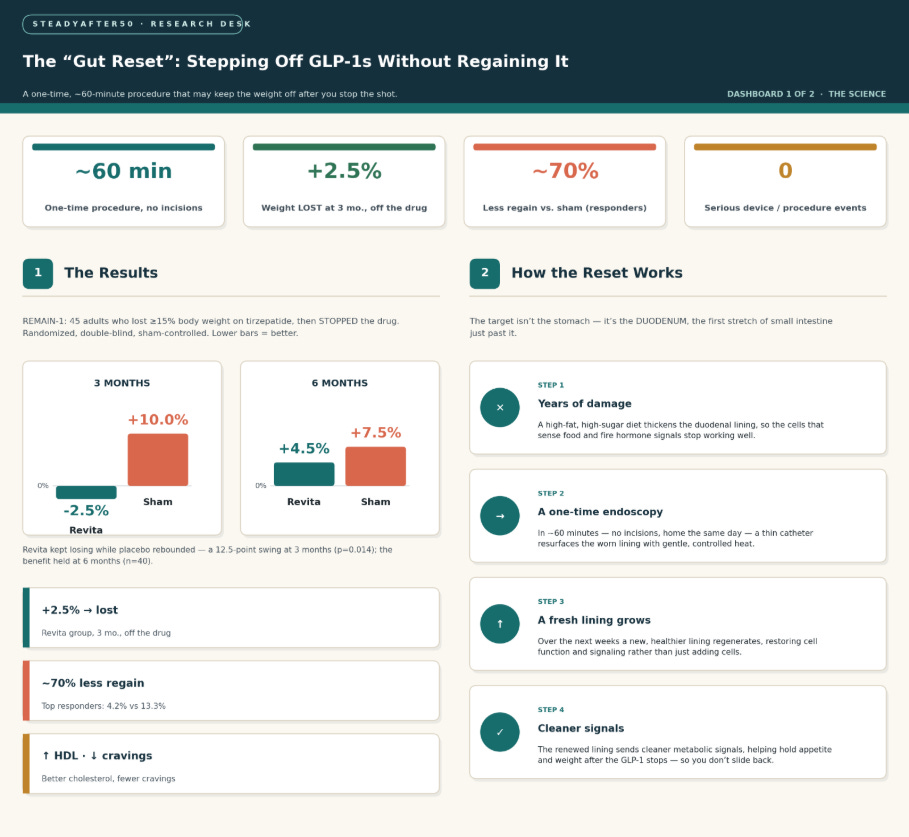
The target isn’t the stomach itself. It’s the duodenum — the first stretch of your small intestine, right where the stomach empties out. This little tube is one of the body’s most important “control rooms” for metabolism. Its inner lining is packed with cells that taste and sense the food coming through and then fire off hormones and nerve signals that tell the rest of your body — pancreas, liver, brain — how to handle that meal.
Here’s the part that rings true for so many of us. The leading theory is that years and years of a high-fat, high-sugar diet can actually damage and thicken that lining. The sensing cells stop doing their job properly. The signals get garbled. Your metabolism drifts toward insulin resistance, stronger cravings, and a body that’s quietly working against your weight-loss efforts.
DMR is a reset button for that lining. In a single outpatient endoscopy — no incisions, roughly an hour, you go home the same day — a doctor threads a thin catheter down to the duodenum and uses precisely controlled heat (warmed water through a small balloon) to gently resurface the damaged inner layer. Over the following weeks, a fresh, healthier lining regenerates in its place — think of it like resurfacing a worn-out tennis court so the lines and bounce work right again. The idea is that this renewed lining sends cleaner metabolic signals, helping keep appetite and weight in check the way a healthy gut is supposed to.
That’s the “new cell bed / restart” concept you may have heard about. And the early data suggests it might do exactly what we’d hope: catch you when you step off the medication, so you don’t slide all the way back.
The results that got everyone’s attention
The study is called REMAIN-1. Researchers took 45 adults with obesity (median age 43, 80% women) who had already lost at least 15% of their body weight on tirzepatide — the ingredient in Zepbound and Mounjaro. Then they did the scary part on purpose: they took everyone off the drug.
Half-ish got the real Revita procedure. The rest got a “sham” (a fake placebo procedure), and — importantly — nobody knew which they’d received. That’s the gold-standard way to run this kind of test. Then they watched what happened to the weight.
At 3 months: the Revita group didn’t just hold steady — they lost another 2.5% on average, even with no medication on board. The sham group regained about 10%. That’s roughly a 12.5% swing in favor of the procedure (statistically solid: p = 0.014).
At 6 months (reported January 2026), the benefit held. Across the main group, Revita patients regained 4.5% versus 7.5% for sham. And in the people who’d lost the most weight on their GLP-1 to begin with — exactly the folks at highest risk of a fast rebound — Revita cut regain by about 70% (4.2% vs 13.3%).
It wasn’t only the scale, either. The Revita group also showed better cholesterol numbers (HDL, the “good” kind, went up) and — this is the one that made me sit up — measurably fewer sweet-food cravings than the sham group. That last finding hints the gut really is sending different appetite signals after the reset, which is the whole point. And on safety: no serious procedure- or device-related complications, and no one dropped out because of side effects.
Why this matters for the way we think about GLP-1s
Picture a different model than “inject yourself forever.” Imagine using a GLP-1 to do what it does best — get the weight off — and then, instead of facing the cliff-edge of stopping, you get a one-time tune-up that helps your own body hold the line. Medication as the on-ramp, a procedure as the bridge, and your renewed gut doing more of the work from there.
That’s the future this research is pointing at. It reframes these drugs from a life sentence into a phase of a plan. For anyone over 50 who’s thought “I can’t picture doing this shot at 70,” that’s a meaningfully different and more hopeful picture.
Now the grown-up part: let’s keep our feet on the ground
I’m optimistic here, but I want to be straight with you, because that’s the deal we have.
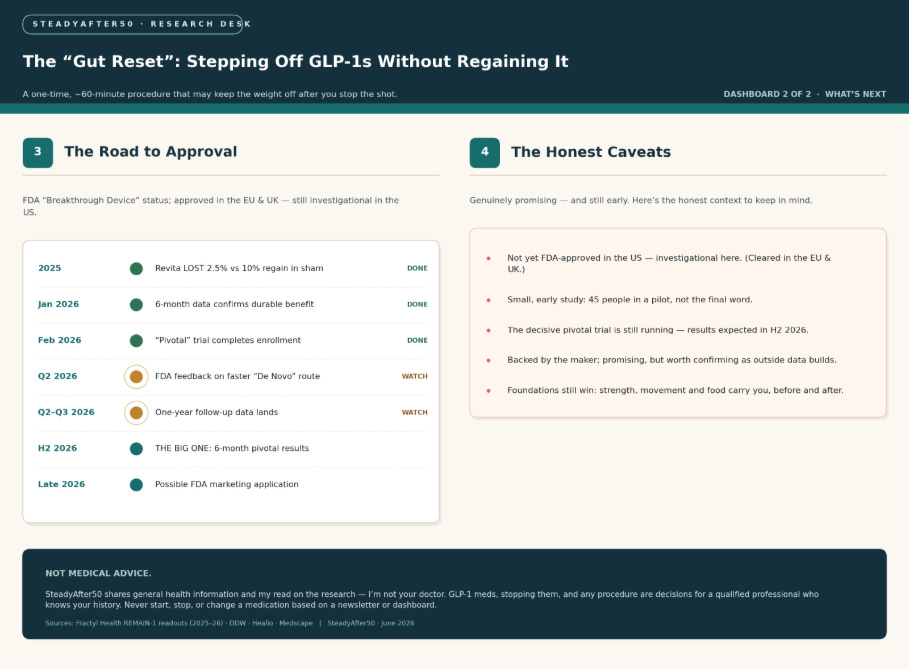
This is early, and it is not yet FDA-approved in the United States. Revita has a “Breakthrough Device” designation (which speeds up review) and is already cleared in Europe and the UK, but in the US it’s still investigational — meaning you can’t go ask your doctor for it tomorrow.
The headline study was also small (45 people) and designed as a pilot, not the final word. The bigger, decisive “pivotal” trial is underway right now, with topline results and a potential FDA filing expected in the second half of 2026. That’s the readout that will really tell us whether this holds up.
So: real promise, real momentum — and still a few important chapters left to be written. I’ll be watching the 2026 readouts closely and will report back here the moment they land.
The SteadyAfter50 bottom line
None of this changes the foundation, and I’d be doing you a disservice if I let a shiny new procedure distract from it. The strength you build and the food you eat are still what carry you — through the medication, through any procedure, and long after. A resurfaced gut still does best inside a body that lifts a little, walks a lot, and eats like it plans to be around a while.
But it’s a wonderful thing to watch science work on the exact problem so many of us lie awake about: how do I keep this off without being tethered to a medication for the rest of my life? For the first time, there’s a credible answer taking shape. And that’s worth getting a little excited about.
Sources & further reading
• Fractyl Health — 6-Month Randomized REMAIN-1 Midpoint Data (Jan 2026)
• Fractyl Health — REMAIN-1 Midpoint Cohort 3-Month Data
• Digestive Disease Week — “Simple ‘Gut Reset’ Procedure May Prevent Weight Rebound”
• Healio — DMR may offer GLP-1 off-ramp while maintaining weight loss
• Medscape — Duodenal Mucosal Resurfacing Curbs Weight Gain Post-GLP-1
Stay steady out there,
Alex — Steadyafter50.com
SteadyAfter50 shares general health information and my own read on the research. It is not medical advice, and I’m not your doctor. GLP-1 medications, stopping them, and any procedure are decisions to make with a qualified healthcare professional who knows your history. Never start, stop, or change a medication based on a newsletter.