
When I started on a GLP-1, I thought I was treating one thing: my weight. That was the whole conversation. Lose the pounds, feel better, move easier. In the back of my mind I hoped there was more to it. I hoped my cardiologist put me on it to help me live a longer and healthier life. I hope to live longer than my middle sister did and I am getting close. I hope to avoid a stroke like my mother, my sister and my grandfather had. I hope to avoid a heart attack like my father, my brother and many of my great uncles had. Lots of hopes here.
What I didn’t understand — and what most people on these medications still don’t — is that the drug doesn’t only act on your appetite. GLP-1 receptors aren’t just in your gut and your brain’s hunger centers. They’re scattered through your heart, your blood vessels, your kidneys, your liver. So when you take one of these medications, it’s quietly doing things in all of those places at once. The side benefits to losing weight and getting more active are many and already proven.
Over the last two years, the science caught up to that. Trial after trial has tested whether these drugs help with conditions that have nothing to do with the number on the scale. Some of those results were strong enough that the FDA formally approved the medication for the new use. Others are promising but still unproven. The honest version — the one nobody puts in a headline — is that those are two very different categories, and it matters which is which.
So let me walk you through both, plainly.

Your heart — approved
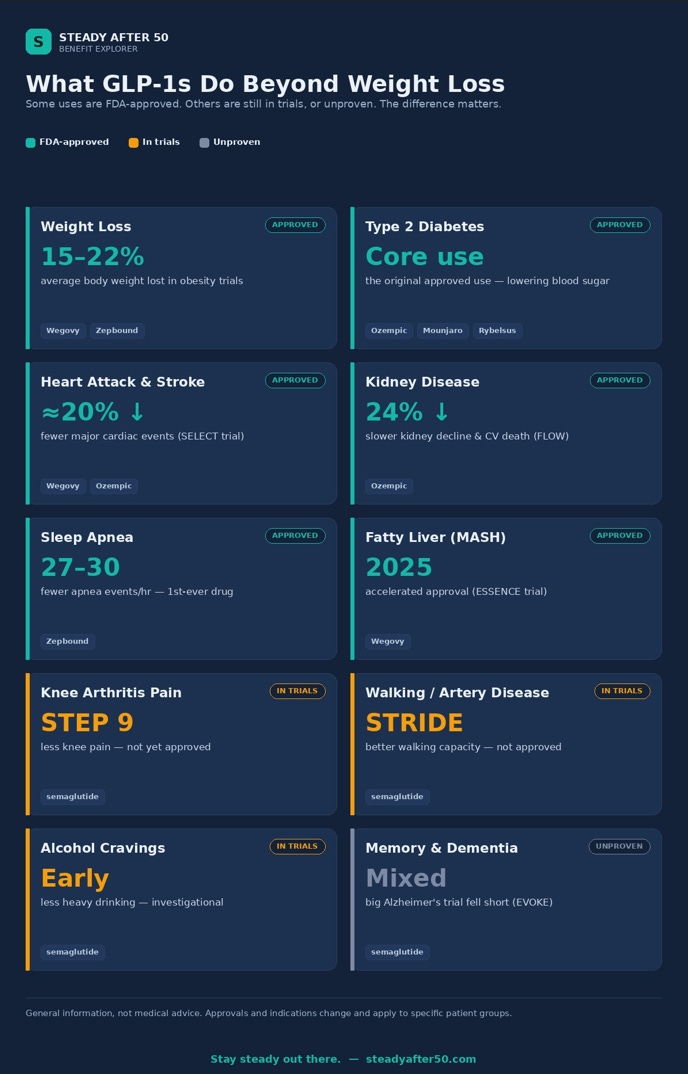
This is the big one. In a large trial called SELECT, semaglutide (sold as Wegovy) was given to adults who were overweight or obese and had existing heart disease — but who did not have diabetes. It cut the risk of major cardiac events — heart attack, stroke, cardiovascular death — by about 20%.
That was strong enough that in March 2024, the FDA approved Wegovy specifically to reduce cardiovascular risk in people with heart disease and obesity. For a lot of people over 50, that single fact reframes the whole medication. It’s not a vanity drug. It’s a heart drug that also happens to help you lose weight.
Your kidneys — approved
In January 2025, the FDA approved Ozempic (also semaglutide) to slow kidney disease in adults who have both type 2 diabetes and chronic kidney disease. The trial behind it, called FLOW, found a 24% reduction in kidney disease getting worse, kidney failure, and cardiovascular death compared to placebo.
Kidney decline is one of those quiet things that creeps up with age and with diabetes, often without symptoms until it’s advanced. A medication that measurably slows it down is a genuinely meaningful development — not hype.
Sleep apnea — approved
If you’ve ever been told you snore like a freight train, or you’ve woken up exhausted after a full night’s sleep, this one’s worth knowing about. In December 2024, the FDA approved Zepbound (tirzepatide) for moderate-to-severe obstructive sleep apnea in adults with obesity. It was the first medication ever approved for sleep apnea — until then, the only real options were a CPAP machine or surgery.
In the trials, people taking tirzepatide had roughly 27 to 30 fewer breathing interruptions per hour of sleep. That’s not a small tweak; that’s the difference between restorative sleep and the chronic, grinding exhaustion that wrecks your days.
Your liver — approved
In August 2025, semaglutide received accelerated FDA approval for MASH — a serious form of fatty liver disease, with moderate-to-advanced scarring, that’s strongly tied to obesity. In the ESSENCE trial, 72 weeks of treatment improved the liver on the two measures that matter most: reduced inflammation and no worsening of scarring.
“Accelerated” is doing some work in that sentence — it means the approval is based on strong interim results, and the final long-term data is still being collected. But for a condition that quietly damages the liver in a huge share of adults, it’s a real step.
The promising-but-not-proven list
Here’s where I want to be careful, because this is exactly where the internet gets loud and the science gets fuzzy. These are areas with encouraging early results — but the medication is not approved for them, and you shouldn’t take one expecting these benefits:
Knee pain. In a trial called STEP 9, semaglutide significantly reduced knee osteoarthritis pain in people with obesity. Encouraging for the over-50 crowd with cranky joints — but not an approved use, and weight loss itself takes pressure off the knee, so it’s hard to separate the two.
Walking distance / circulation. The STRIDE trial found semaglutide improved walking ability in people with peripheral artery disease and diabetes. Promising, not approved.
Alcohol cravings. Early trials suggest GLP-1s may reduce heavy drinking and cravings, likely by acting on the brain’s reward system. This is genuinely interesting and being actively studied — but it’s investigational, not a treatment you can be prescribed for that purpose.
Memory and dementia. This one gets oversold. Some observational data hints at lower dementia rates in GLP-1 users — but the largest dedicated Alzheimer’s trial (EVOKE) did not show that semaglutide slowed the disease. So: an open question, not a benefit you can count on.
What this means for you
If you’re on a GLP-1, or thinking about one, the takeaway isn’t “this drug fixes everything.” It’s that the conversation has grown well beyond weight — and some of those expanded uses are now backed by real approval, not just optimism.
That’s worth a specific conversation with your prescriber. If you have heart disease, kidney issues, sleep apnea, or fatty liver, the medication’s role in your life might be bigger than you realized — and that can change how you and your doctor weigh staying on it. And if someone tries to sell you a GLP-1 as a memory pill or an anti-aging miracle, you now know enough to raise an eyebrow.
The honest, calm version is the most useful one: these are powerful medications doing more than we first understood — and the people who benefit most are the ones who understand what’s actually proven, and make the decision with a doctor who knows their numbers.
Sources & further reading
Heart — SELECT trial: NEJM · FDA approval (March 2024)
Kidney — FLOW trial: NEJM · FDA approval (Jan 2025)
Sleep apnea — FDA approval of Zepbound (Dec 2024)
Liver (MASH) — ESSENCE trial / accelerated approval (Aug 2025)
Knee osteoarthritis — STEP 9 trial
Peripheral artery disease — STRIDE trial (The Lancet)
Alcohol use — Semaglutide AUD randomized trial
Dementia — EVOKE Alzheimer’s trial results
Disclaimer: I’m not a doctor, dietitian, or pharmacist. This reflects my personal experience and general information only — not medical advice. Drug approvals and indications change; talk to your prescriber about your specific situation and what these medications are right for in your case.
Stay steady out there,
Alex — Steadyafter50.com