
Why Protecting Your Muscle Matters on the GLP-1 Journey
After 50, we naturally lose muscle every year — and rapid weight loss from a GLP-1 can accelerate that process. Muscle is what keeps us strong, mobile, and metabolically healthy, so protecting it isn’t optional — it’s the whole point. When I started my GLP-1 medication, the weight came off quickly, but I was determined not to let my muscle come with it. Here’s the simple routine I used to hold on to strength while losing fat.
The Secret No One Told Me
When you’re carrying extra weight, your body is quietly building muscle just to move through the day — your legs, back, and core are working hard whether you realize it or not. But as the weight comes off on a GLP-1, that built-in resistance disappears. Your body no longer has a reason to hold onto that muscle. That’s the part nobody warns you about. You have to replace that natural load with something intentional — a weight-bearing workout that signals to your body: keep the muscle, we still need it.
What I did (the 3-part routine)
Protein first, every meal. I aimed for roughly 30 grams of protein per meal — eggs, Greek yogurt, chicken, fish, cottage cheese, or a clean whey shake. On low-appetite days, I started with the protein and ate the rest only if I had room.
Move Every Day. I did strength training 2 times a week (working toward 3), walked daily for circulation and steady calorie burn, and added aquafit 3 times a week. Aquafit was the hero in the early weeks — the water cushioned my joints during those early weeks when movement was still painful, and a hot tub afterward eased the soreness so I’d actually come back the next day.
Sleep and hydration (and supplements can help too). Aim for seven to eight hours of consistent sleep — that’s when your body actually rebuilds the muscle you’re training. Drink water steadily through the day; on a GLP-1 it’s easy to under-drink because thirst can feel muted, and even mild dehydration drains strength, focus, and recovery. A few simple supplements can quietly support the work too: 5g of creatine monohydrate daily, vitamin D and B12 if your doctor has flagged them, and electrolytes on heavy-sweat days. Boring habits, big payoff.
What I tracked
Three simple measurements gave me a real picture of progress: a weekly weigh-in at the same time of day in similar clothes; a tape-measure check at the waist, arms, chest, hips, and thighs once a month so I could actually see the changes; and a written log of my strength-training weights over time. Watching those numbers move — even slowly — told me I was getting stronger, not just lighter.
What I’d tell a friend starting tomorrow
Chase protein and fiber. Look at the big picture: nutrition, strength, movement, hydration, and sleep — each one is a small lever, but pull all five and your body holds onto its muscle while the GLP-1 does the appetite work. No single thing carries the whole load.
A simple starter workout (free weights or machines)
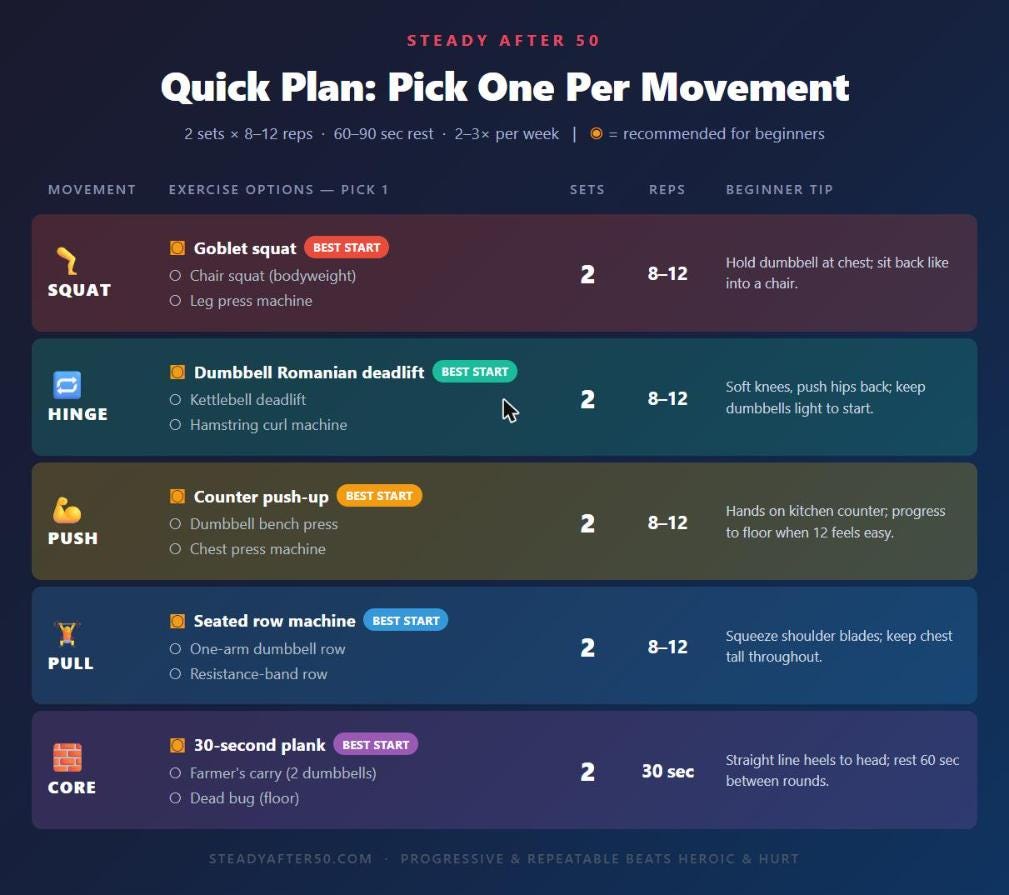
If you’re new to lifting, keep it boring and consistent. Two to three 30-minute sessions per week is plenty to start. Pick ONE option from each movement below, do 2 sets of 8–12 reps, and rest about 60–90 seconds between sets.
Start lighter than you think for the first two weeks. Don’t push heavier than your body is ready for — a setback in week two can cost you a month. When 12 reps feel easy with good form, add a small amount of weight. Progressive, gentle, and repeatable beats heroic and hurt every time.
Click links below to view video of exercise
Squat: bodyweight chair squat, goblet squat, or leg press machine.
Hinge: dumbbell Romanian deadlift, kettlebell deadlift, or hamstring curl machine.
Push: push-up (floor or counter), dumbbell bench press, or chest press machine.
Pull: one-arm dumbbell row, resistance-band row, or seated row machine.
Carry / Core: farmer’s carry with two dumbbells, or 30-second plank.
If this helped
Hit the like button, leave a comment with your own GLP-1 tip, and share this with one friend who’s on the journey.
Disclaimer (the boring but important part)
I’m not a doctor, dietitian, pharmacist, or personal trainer. This newsletter shares my personal experience and general information — it is not medical advice and should not be used to diagnose, treat, or replace care from a qualified healthcare professional. GLP-1 medications, supplements, and exercise programs all have risks. Talk with your own doctor before starting, stopping, or changing any medication, supplement, diet, or workout routine — especially if you have an existing health condition.
Sources and further reading
Protein needs in older adults — Harvard T.H. Chan School of Public Health: https://nutritionsource.hsph.harvard.edu/protein/
Strength training and healthy aging — NIH National Institute on Aging: https://www.nia.nih.gov/health/exercise-and-physical-activity/four-types-exercise-can-improve-your-health-and-physical
Creatine monohydrate overview — International Society of Sports Nutrition position stand: https://jissn.biomedcentral.com/articles/10.1186/s12970-017-0173-z
GLP-1 medications and lean mass considerations — Mayo Clinic: https://www.mayoclinic.org/healthy-lifestyle/weight-loss/in-depth/weight-loss-drugs/art-20044832
Sleep and muscle recovery — American Academy of Sleep Medicine: https://sleepeducation.org/healthy-sleep/
Stay steady out there,
Alex — Steadyafter50.com