
Why the Pool + the Weight Room Is the Best Partnership Your Body Gets After 50
I’ll be honest — I thought aquafit was for people who didn’t really want to work out. I pictured retirees bobbing around to oldies. I was wrong, and I was humbled. My first aquafit class left me sore in places I didn’t expect, and my joints felt better the next morning than they had in months. I knew after doing aquafit regularly 3x a week for six months or more that I ought to start incorporating gym workouts. I needed to improve my balance and strength outside of the pool and gain some confidence in my body again. I needed to start lifting weights to get more results. I solved the pain issue and the movement issue I was experiencing. I tried working out in the gym by myself but found I didn’t know how to use all the machines or what kind of workout would be best. I knew I didn’t want to go in, go hard and hurt myself. So, I signed up for sessions with a personal trainer to figure that stuff out for me and help me get a good workout. My ability to do things has improved. I used to only dream of being able to jog, now I can. I still like jogging in the pool but I can jog and dance and go up and down stairs like I couldn’t a year ago. Movement in almost everything has improved and so has my strength and ability to walk farther. I have had a session a week for over a year and a half now with my trainer. I have added a session in the gym by myself and am working towards a 3x a week gym and 2x a week aquafit and other exercise the rest of the week with a good rest day. After some weight loss coupled with strength training and aquafit … my knees are coming back. My knees stopped complaining, and for the first time in years I was actually building visible muscle. I wish someone had told me about this combination at 50, not 59.
What Nobody Tells You About Water and Weights Together
Here’s the thing about water exercise that the gym crowd misses: buoyancy removes up to 90% of your body weight from your joints, which means you can work your muscles hard with almost no impact penalty. You build cardiovascular fitness, muscular endurance, and range of motion — all without the inflammation and soreness that keeps so many of us off land-based exercise. But here’s the catch: water alone won’t build the bone-strengthening, metabolism-boosting muscle density you need after 50. That requires load-bearing resistance. The combination — pool for cardio and joint recovery, weights for bone and muscle — is genuinely the sweet spot for our age group. It’s not either/or. It’s both.
What I Did — The Weekly Two-Part Plan
Aquafit 2x or 3x times a week. I aimed for classes that were at least 45 minutes and included both aerobic segments (jogging in place, jumping jacks, cross-country ski) and toning segments (water dumbbells, flutter kicks). The key is water depth — chest-high is ideal. Too shallow and you lose the buoyancy benefit; too deep and you’re just floating.
Resistance training 2x a week — on non-aquafit days. I started with machines rather than free weights because the fixed range of motion is kinder on joints while you’re building the stabilizer muscles you need. Leg press, chest press, seated row, lat pulldown. 3 sets of 12. Done in 30 minutes. Nothing heroic.
One full rest day per week — non-negotiable. I used to think rest days were for people who weren’t committed. Now I understand they’re when the adaptation actually happens. I sleep better, I’m less stiff, and I come back to the next session genuinely stronger.
What I Tracked
My trainer kept track of all the information on how much I was lifting and improving. She kept it simple: the weight on each machine (increased it by the smallest increment available the moment 12 reps felt easy — that’s progressive overload in real life); my step count on aquafit days (the pool is active, but walking to and from still counts); and a simple pain diary or check in — knee, hip, and lower back rated 1–5 before and after each week. Watching and knowing those pain scores drop from 4s to 1s and staying there was more motivating than anything else.
What I’d Tell a Friend Who Says Their Knees Are Too Bad to Exercise
Get in the water first. Seriously. Your knees don’t know they’re supposed to hurt in the pool. Start there, build the muscles around the joint, and then — slowly, carefully — try the machines. The five levers I keep coming back to are nutrition, strength, water movement, sleep, and stress. Pool work covers two of those at once: strength endurance and stress relief. It’s one of the most efficient things I’ve added to this whole journey and the biggest payoff. There’s a reason we see people rehab knees, hips and shoulders in the pool. It’s a great place to start and maybe there’s a hot tub or sauna at the end for a reward.
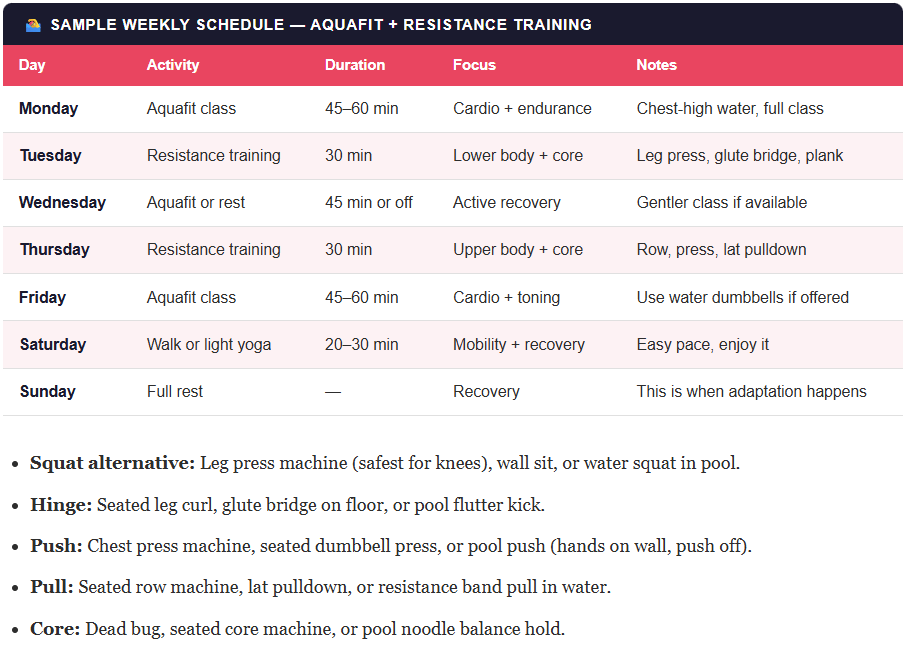
The Aquafit + Weights Weekly Schedule That Works
Here’s what a realistic week looks like. You don’t need to do all of this from day one — but this is the target to build toward over your first six weeks. Each resistance session is about 30 minutes. Each pool session is 45–60 minutes including warm-up.
On resistance training days, don’t push into pain — push to the edge of comfortable effort. There’s a difference between muscle fatigue (good) and joint pain (stop). If a machine causes sharp pain, skip it that day and ask a trainer or physical therapist for a modification. No single exercise is irreplaceable.

If this helped
Hit like if you’re a pool person — or if you’re now thinking about becoming one. Drop a comment with your favorite aquafit move, and share this with anyone who says they can’t exercise because of joint pain. That’s exactly who needs to see it.
Disclaimer (the boring but important part)
I’m not a doctor, dietitian, pharmacist, or personal trainer. This newsletter shares my personal experience and general information — it is not medical advice and should not be used to diagnose, treat, or replace care from a qualified healthcare professional. GLP-1 medications, supplements, and exercise programs all have risks. Talk with your own doctor before starting, stopping, or changing any medication, supplement, diet, or workout routine — especially if you have an existing health condition.
Sources and Further Reading
Aquatic exercise and arthritis — Arthritis Foundation:
https://www.arthritis.org/health-wellness/healthy-living/physical-activity/other-activities/aquatic-exercise-and-arthritis
Water-based exercise and body composition in older adults — Journal of Aging and Physical Activity:
https://journals.humankinetics.com/view/journals/japa/
Resistance training benefits after 50 — NIH National Institute on Aging:
https://www.nia.nih.gov/health/exercise-and-physical-activity
Combined aerobic and resistance training for older adults — Medicine & Science in Sports & Exercise:
https://journals.lww.com/acsm-msse/
Buoyancy and joint offloading in hydrotherapy — Physical Therapy Reviews:
https://www.tandfonline.com/toc/yptr20/current
Stay steady out there,
Alex — Steadyafter50.com