
The News, In Plain English
For most of my GLP-1 journey, I wondered about another option. A pill was developed and then another. It doesn’t do as much as the shot. For instance I am taking Zepbound shots weekly, FDA approved for weight reduction. The Foundayo (Orforglipron) pill made by Eli Lilly, is an FDA approved daily option for weight management. I wondered about the differences and if a pill would work for me. I’m not sure I have it all figured out but this is where I’m at and what I’ve found:
How they work differently
Tirzepatide is a dual receptor agonist — it activates both GLP-1 and GIP receptors simultaneously. Orforglipron is a single receptor agonist, targeting only GLP-1 receptors.
Activating both pathways explains why tirzepatide often leads to better blood sugar control and more weight loss than drugs that only target GLP-1. What makes orforglipron different from every other GLP-1 drug is that it’s a small molecule — oral, non-peptide — which is a genuine pharmacological achievement.
I’m like what???
Here’s a plain-language breakdown:
How Zepbound and Foundayo Work (In Plain English)
First, the shared foundation
Both drugs mimic a hormone your body naturally releases after you eat called GLP-1. That hormone does three things: tells your brain you’re full, slows down how fast food leaves your stomach, and signals your pancreas to manage blood sugar. Both drugs basically amplify and extend that signal — so you feel fuller longer, eat less, and your blood sugar stays steadier.
Where they split
Zepbound (tirzepatide) — the “two-key” drug
Think of your body’s hunger and blood sugar system as a building with two doors. Zepbound carries two keys — one for the GLP-1 lock and one for a second lock called GIP. Opening both doors at once produces a stronger effect than either one alone. That’s why it tends to deliver more weight loss — it’s hitting two separate systems simultaneously.
Foundayo (orforglipron) — the “one-key” drug
Foundayo only carries the GLP-1 key. It’s still effective — one-key drugs have been on the market for years (Ozempic, Wegovy work the same way) — but you’re only unlocking one door. The effect is real, just not as amplified.
Why the pill form matters mechanically
Zepbound is a large peptide molecule — basically a chain of amino acids, similar in structure to a protein. Your digestive system would break it down before it ever reached your bloodstream, the same way protein gets digested when you eat it. That’s why it has to be injected — bypassing digestion entirely.
Orforglipron is a small molecule — an entirely different type of chemistry. It’s small and stable enough to survive the digestive process and absorb through your gut wall into your bloodstream, just like a typical pill (aspirin, blood pressure meds, etc.). That’s the actual scientific breakthrough here — nobody had cracked an oral GLP-1 drug that worked this well until now.
The practical tradeoff in one sentence
Zepbound hits harder because it unlocks two systems at once, but it has to be injected to survive your body. Foundayo is less powerful but you just swallow a pill in the morning and move on with your day.
So, the first pill on the market was difficult to schedule and take properly. Yes, there was an oral option — semaglutide, sold as Rybelsus — but it came with a rulebook. Take it on an empty stomach, first thing, with no more than a few sips of plain water, then wait half an hour before you eat, drink, or take anything else. Miss the window and you might as well have swallowed a breath mint for all the medicine your body absorbed. If you miss a week of meds the need to contact doctor about how to restart. For a lot of us over 50 who already juggle a morning lineup of pills, that was a hard sell.
That’s the backdrop for why this summer’s news landed the way it did. In 2026 the FDA approved orforglipron — Eli Lilly’s oral GLP-1, sold under the brand name Foundayo — for weight loss. The headline feature isn’t just that it’s a pill. It’s that you can take it any time of day, with or without food, with or without water. No fasting window. No stopwatch. That single difference is why people are paying attention, and why more people are asking “should I switch?”. I’m one of them. I just want to get away from giving myself a shot every week. I have to psych myself up every week to give myself the shot and then eat very carefully the next day or two. A pill each day seems easier but does it come with different side effects and issues?
Why “Any Time, No Food Rules” Actually Matters
I want to be careful here, because it’s easy to make convenience sound like a small thing. It isn’t, and here’s why. The medicine you actually take beats the medicine you take perfectly on paper but skip in real life. A weekly injection asks you to handle a needle, store pens in the fridge, and get comfortable with something a lot of people find genuinely unpleasant. The old oral option asked you to build your whole morning around a 30-minute fasting window. Both are doable. Both also give people a reason to quit.
A pill you can swallow with your coffee, or at lunch, or whenever you happen to remember, makes it much easier. For anyone who doesn’t like shots — and I’ve heard from plenty of readers who put off starting for months because of exactly that — this is the option that finally gets them in the door. I’m one of the folks that delayed due to the shot for about six months while I thought about the meds and giving myself a shot every week. Another reason I wasn’t sure it would work for me. The cost for the pill is lower and that will make it easier for out-of-pocket or maybe even insurance approval more broadly. There’s also a behind-the-scenes reason this matters: orforglipron is a small-molecule pill, which is much easier and cheaper to manufacture at scale than the injectables. The hope for the pill is that there will be a bigger supply and less shortage drama for those taking it.
The Honest Trade-Off: Convenience vs. Magnitude
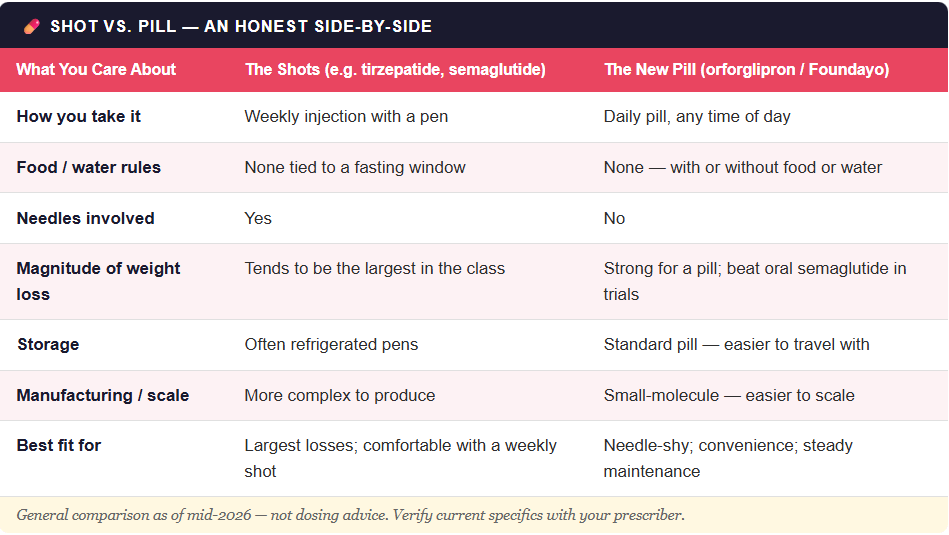
Now the part the excited headlines tend to skip. Convenience is one axis. How much weight you lose is a different axis, and they don’t line up neatly. In the trial data, orforglipron outperformed the older oral semaglutide for weight loss — so pill-to-pill, it’s the stronger option. But the injections, especially tirzepatide, still tend to produce the largest average losses of anything in this class. That’s the tension in one sentence: the pill’s superpower is convenience and no needles; the shots’ superpower is still magnitude.
So this isn’t a story about a new pill making the shots obsolete. It’s a story about the menu getting longer. The right pick depends on what you’re optimizing for — the last stubborn 40 pounds, or a needle-free way to hold steady and keep appetite quiet. Averages from a trial also aren’t a prediction about you specifically; individual response in this whole drug class is all over the map. As always with this stuff — accurate as of mid-2026, and worth verifying the current details with your own doctor, because approvals and labels move fast. The chart below references shot and pen vs. pill.
Would I Actually Switch? Where My Head Is At
Here’s where I have to be honest and boring at the same time. I’m not going to tell you what to do, and I’m certainly not going to change my own medication based on a press release. But what I’m personally thinking about:
What am I optimizing for right now? I’m past the big-loss phase and into what I have left maybe 10 or 15 pounds and then maintenance. If I were still chasing a large amount of weight, the magnitude edge of the injections would weigh heavier. Since I’m not, convenience gets a bigger vote than it would have two years ago.
How much does the needle actually bother me? Truthfully, I don’t like giving myself shots. I dread it every week but I am careful and go thru with it. The benefits outweigh the deficits for me. I am motivated by my results. If you’re someone who still dreads it every single week, that’s a real, legitimate reason to talk to your doctor about a switch. “I’ll actually stick with it” is a medical advantage, not a cop-out.
What does my doctor say about my specific situation? This is the one that actually decides it. Switching medications isn’t a lateral move you make on a whim. Dosing, how you’d transition, side effects, what my labs look like, cost and coverage — that’s a conversation, not a comment-section poll. I haven’t had this conversation with my cardiologist yet. I am thinking this could be a way to go on maintenance and not do shots forever.
My honest bottom line: the pill is genuinely good news, and it’s the option I’d raise first if I were needle-shy or starting from scratch today. But newer and more convenient are not the same as better for me. I’m keeping an open mind, I’m bringing it up at my next appointment. I don’t want to switch a thing until someone who’s seen my chart tells me it makes sense or until there’s a good study out. That’s not caution for caution’s sake — it’s just how I’ve learned to treat every one of these headlines.
A Few Things This Pill Doesn’t Change
One more grounding note before you get too swept up, because I’d want a friend to tell me this. Pill or shot, the medicine is the assist, not the whole game. The protein, the resistance training, the sleep, the boring weekly weigh-in — all of that still does the heavy lifting on keeping muscle and feeling good after 50. A more convenient delivery method makes it easier to stay consistent with the medication. It does not replace the habits underneath it. If anything, the easier the medicine gets, the more the habits become the thing that actually distinguishes a good outcome from a disappointing one.
If this helped
Hit like if the pill-versus-shot question has been rattling around your head too — mine’s been full of it. Drop a comment telling me which one you’re leaning toward and why, and share this with a friend who’s been putting off starting because of the needle. And whatever you’re weighing, bring it to your own doctor before you change anything — that’s the one piece of advice I’ll give you for free every single time.
Disclaimer (the boring but important part)
I’m not a doctor, dietitian, pharmacist, or personal trainer. This newsletter shares my personal experience and general information — it is not medical advice and should not be used to diagnose, treat, or replace care from a qualified healthcare professional. GLP-1 medications, supplements, and exercise programs all have risks. Talk with your own doctor before starting, stopping, or changing any medication, supplement, diet, or workout routine — especially if you have an existing health condition.
Sources and Further Reading
Eli Lilly — FDA approves Foundayo (orforglipron), the only GLP-1 pill:
https://investor.lilly.com/news-releases/news-release-details/fda-approves-lillys-foundayotm-orforglipron-only-glp-1-pill
AJMC — FDA approves Lilly’s oral GLP-1 orforglipron for obesity:
https://www.ajmc.com/view/fda-approves-lilly-s-oral-glp-1-orforglipron-for-obesity
ScienceDaily — coverage of the oral GLP-1 approval and trial data:
https://www.sciencedaily.com/releases/2026/07/260707054111.htm
Stay steady out there,
Alex — Steadyafter50.com