
The Finish Line Isn’t Where You Think It Is
I hit my goal weight on a Monday morning. I stepped on the scale, saw the number I’d been working toward for months, and felt — honestly — a little lost. Because nobody had told me what comes after this moment. The medication, the meal planning, the protein tracking — all of it had been aimed at a number. Now I had the number. What did I do now?
What I didn’t know then, and have spent the months since learning: hitting your goal weight is not the end of the journey. It’s the start of a different one. And if you don’t prepare for it, most of the weight comes back — studies consistently show that most people regain significant weight within two years of reaching their goal. Not because they failed. Because nobody gave them a map for what comes next.
This is that map.
First: The Mindset Has to Change
While you were losing weight, your goal was a calorie deficit — eating less than you burned. Maintenance means eating exactly what you burn. That sounds simple. It isn’t. After months or years of restriction, eating “enough” feels like overeating. Your brain has recalibrated. Old hunger cues don’t work the same way. And the habits that got you here — eating less, moving more — need to be recalibrated for a new target.
The biggest mistake I see people make at goal weight: they relax everything at once. Less protein, less structure, back to old patterns. Within a few weeks the scale starts moving in the wrong direction and they blame themselves. It’s not a willpower problem. It’s a planning problem. Maintenance requires the same intentionality as weight loss — just pointed in a different direction.
If You’re on a GLP-1: The Step-Down Conversation
If you used Ozempic, Mounjaro, Wegovy, or Zepbound to get here, talk to your prescriber about a maintenance dosing strategy. There’s no single protocol — it depends on your body, your habits, and your medical history. But here’s what the step-down typically looks like in practice:
Once you’ve held goal weight for 4 to 8 weeks and your habits feel solid, your doctor may begin reducing your dose to the lowest level that keeps appetite regulated
Some people move to every-other-week dosing. Some stay on a low maintenance dose indefinitely. Some come off entirely with the right habits in place.
The first 2 to 4 weeks after any dose reduction usually brings increased hunger — your body adjusting to less appetite suppression. This is normal and expected.
Watch for slow upward creep on the scale. Two to three pounds is normal fluctuation. Five or more pounds trending upward over a few weeks is a signal to talk to your doctor before it becomes ten.
The most critical thing during step-down: do not reduce your protein. This is the moment almost everyone slips. The medication was doing some of the hunger management work. Now your habits have to do more of it. Protein is your most powerful hunger regulation tool without the drug — and it’s what protects the muscle you worked so hard to keep.
Let’s Talk About Ozempic Face
I’m going to say the thing people are googling at 2am but not saying out loud in their support groups: significant weight loss changes your face. Especially after 50. Especially on GLP-1s, where the loss can be rapid.
What people call “Ozempic face” is the face version of what happens everywhere on your body when you lose weight: fat loss. Your face has fat deposits — in your cheeks, under your eyes, along your jaw — that contribute to fullness and volume. When weight comes off quickly, that facial fat goes too, leaving the face looking hollowed, gaunt, or older than it did before the weight loss. After 50, this is more visible because skin elasticity is lower. Skin that bounced back at 30 takes much longer to adapt at 55.
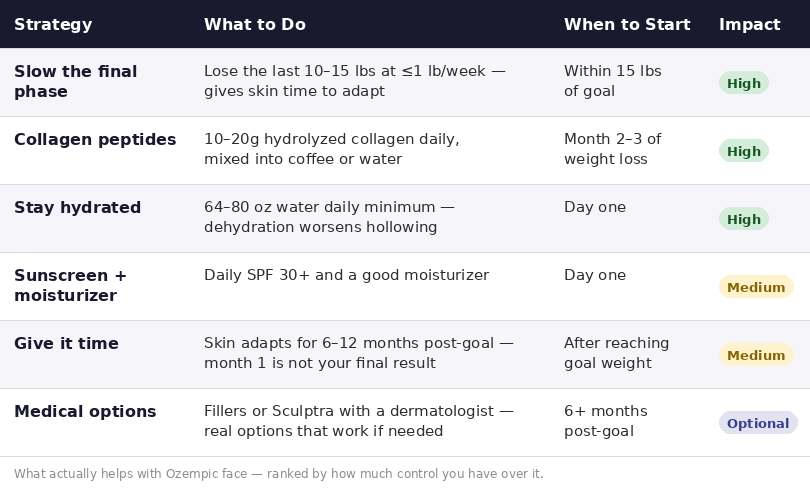
Here’s what actually helps — in order of how much control you have over them:
Slow the final phase of loss. Losing the last 10 to 15 pounds slowly — one pound a week or less — gives your skin more time to adapt than rapid loss does.
Collagen peptides. Hydrolyzed collagen (10 to 20 grams daily, mixed into coffee or water) has reasonable evidence for supporting skin elasticity. I started this at month three and noticed a difference by month five. It’s not magic, but it’s real.
Stay hydrated. Dehydration makes hollow skin look worse and more creped. This is one of the most controllable factors and most people underestimate it.
Time. For most people, skin continues adapting for 6 to 12 months after reaching goal weight. What you see at month one is not what you’ll see at month twelve.
Basic skincare. Sunscreen and a good moisturizer affect how skin responds to volume changes more than most people realize. Simple and worth starting now if you haven’t.
Medical options if you want them. Fillers, Sculptra, and similar treatments are increasingly common for people who’ve lost significant weight. These are personal decisions — but they’re real options, they work, and a dermatologist (not just your GP) is the right person to talk to.
The Five Habits That Actually Keep the Weight Off
The research on long-term weight maintenance is actually pretty consistent. People who keep weight off share a handful of habits. These are them:
They never stopped eating protein. A hundred grams a day, every day, permanently. This is the single biggest predictor of not regaining. Protein keeps you full, protects muscle, and costs your metabolism more to process than fat or carbs. It doesn’t stop mattering at goal weight — it matters more.
They weigh themselves regularly. Not obsessively — once a week. The people who maintain long-term catch a 3-pound regain before it becomes 15. Awareness is not the enemy. Avoidance is.
They stay active consistently. Not intensely — consistently. A daily walk beats three gym sessions a week that you eventually quit. Movement that fits your real life is the only kind that works long-term.
They protect their sleep. Sleep deprivation undoes maintenance faster than almost anything else. One bad week and hunger hormones spike, cravings return, and the scale moves. Good sleep is maintenance medicine — treat it that way.
They have a recovery plan. Everyone has a bad week — travel, stress, illness, holidays. The people who maintain long-term aren’t the ones who never slip. They’re the ones who have a plan for getting back within a few days, not a few months. Know your reset protocol before you need it.
If this helped
Hit like if you’re navigating the “now what” phase — or getting close to it. Drop a comment with the maintenance habit you think will be hardest for you to stick with. And share this with someone on a GLP-1 who’s close to their goal. The step-down conversation with their doctor will go better if they walk in prepared.
Disclaimer (the boring but important part)
I’m not a doctor, dietitian, pharmacist, or personal trainer. This newsletter shares my personal experience and general information — it is not medical advice and should not be used to diagnose, treat, or replace care from a qualified healthcare professional. GLP-1 medications, supplements, and exercise programs all have risks. Talk with your own doctor before starting, stopping, or changing any medication, supplement, diet, or workout routine — especially if you have an existing health condition.
Sources and Further Reading
• Wilding JPH et
al. (2021). Once-Weekly Semaglutide in Adults with Overweight or Obesity. NEJM. (Weight regain data post-medication)
• Bhasin S et al. (2022). Sarcopenia and GLP-1 receptor agonists: muscle mass preservation strategies. Journal of Cachexia, Sarcopenia and Muscle.
• Shaw G et al. (2017). Vitamin C-enriched gelatin supplementation before intermittent activity augments collagen synthesis. American Journal of Clinical Nutrition.
• Wing RR & Phelan S. (2005). Long-term weight loss maintenance. American Journal of Clinical Nutrition. (National Weight Control Registry data on maintenance habits)
Stay steady out there,
Alex — Steadyafter50.com